Introduction
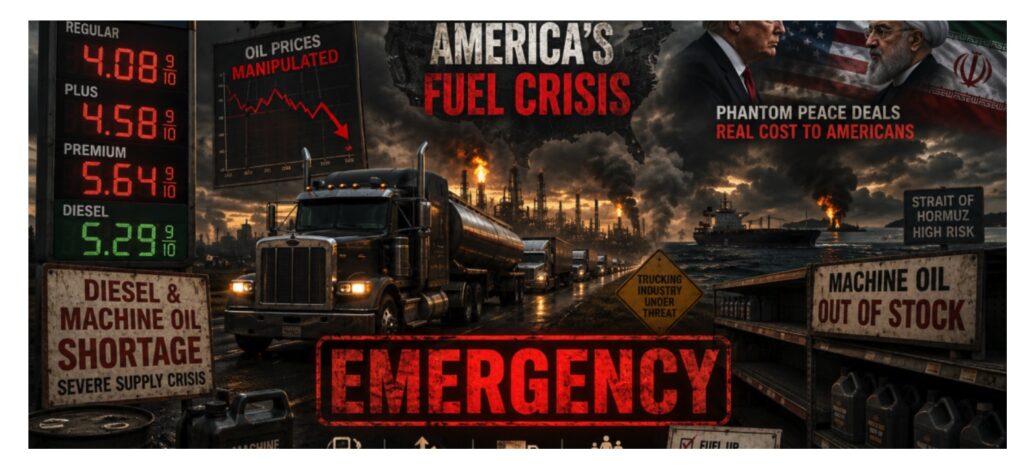
The United States is now in the middle of an energy emergency that the political establishment refuses to name. Diesel prices are climbing even as official inflation narratives try to soften the blow. Gasoline is already painfully expensive for ordinary households. Machine oil, the overlooked lubricant that keeps commercial engines and industrial machinery alive, is facing what one industry source calls the most severe supply shortage in modern American history. And at the center of all of this are the endless, self-serving, and repeatedly false reports that the Trump administration is on the verge of a “deal” with Iran that will end the war, reopen the Strait of Hormuz, and somehow make everything cheap again.
As of August 4, 2026, the national average gasoline price in the United States sits at $4.089 per gallon, while California drivers are paying $5.648 per gallon on average. Those numbers are not the result of an organic market. They are the byproduct of a deliberate political game in which the White House uses dramatic rumors and heavily leaked “peace deal” narratives to push oil futures down long enough for the administration, and select insiders, to benefit. Meanwhile, the physical supply of diesel and machine oil is tightening to crisis levels. The temporary price dips manufactured by Iran deal headlines are masking a structural catastrophe that is about to hit every American who drives, eats, or depends on a delivery truck.
This report examines how the Trump administration has weaponized the Iran conflict as a tool of oil price manipulation, why ordinary Americans continue to pay record prices while insiders profit, and why the trucking industry — the lifeblood of American food and product delivery — is now being crushed between diesel shortages and collapsing supply. It also explains why the music will stop, possibly within weeks, and why families, businesses, and truck fleets should stock up on food, essentials, fuel, and machine oil immediately.
The Trump Administration’s On Going Oil Price Manipulation – The “Let’s Make A Deal” Game With Iran
The pattern is impossible to miss. Every time oil prices climb high enough to create political pain, a new story emerges from Washington about an imminent U.S.-Iran peace agreement. Headlines tout a ceasefire, a memorandum of understanding, a draft deal to reopen the Strait of Hormuz, or a surprise breakthrough that will supposedly dismantle Iran’s nuclear program and remove enriched uranium. Oil futures immediately drop. Then the deal collapses, an Iranian official denies it, or the White House quietly moves on to the next threat of military strikes. The cycle repeats. It is not diplomacy. It is price management by press release.
The most dramatic example came in June 2026, when reports of a potential U.S.-Iran agreement to reopen the Strait of Hormuz sent U.S. crude oil futures down by 3.2 percent to $84.88 per barrel, with Brent falling 3.4 percent to $87.33. At the time, a senior Trump administration official claimed there was an 80 percent chance that the U.S. and Iran would sign an agreement in the coming days. Iran’s Foreign Minister, however, said no such memorandum of understanding had ever been closed. The contradiction did not stop the market plunge. It was exactly the kind of false signal that lets large traders and politically connected insiders position themselves before the public fully understands what is happening.
A CounterPunch investigation dated July 27, 2026 provides a more detailed timeline. A Memorandum of Agreement between the U.S. and Iran was announced on June 17, 2026, and for a brief moment global oil prices collapsed from roughly $100 per barrel to around $67 for West Texas Intermediate and $70 for Brent. The MOU quickly fell apart, but the damage was done: traders who believed the deal had already sold their positions, consumers saw prices dip just enough to be told relief was coming, and the administration claimed a diplomatic victory that never existed. CounterPunch describes this as part of a “Trump’s Iran war” and “US oil shortage deception”. The article highlights how the supposedly peace-making MOU was used to suppress oil prices at a moment when actual supply shortages were worsening.
This was not an isolated incident. As early as May 28, 2026, reports of a potential ceasefire agreement briefly raised hopes, but traders were already skeptical that a U.S.-Iran nuclear deal would happen within the year. CNBC reported that hopes were fading, despite the ceasefire narrative. Then, by June 22, 2026, the administration was threatening fresh strikes on Iran, and oil prices were fluctuating wildly in response to the whiplash between war and “peace” signaling. Trump threatened additional military action, and the Strait of Hormuz closure remained a live factor. The market no longer knew whether to price in war or peace. That uncertainty is itself a tool: it allows the administration to create sudden drops in price whenever needed.
There is also evidence that this manipulation is being noticed by analysts and investors. Middle East Eye reported on the “jolt” in oil and stocks following the U.S.-Iran deal news, quoting observers who noted that the market reaction looked more like insider trading and outright manipulation than organic price discovery. TradeEdgePro observed that the U.S.-Iran deal produced a sharp drop in oil prices and described the agreement as a strategic move to stabilize or manipulate market conditions. JFeed’s analysis went further, saying that Trump’s approach involved generating optimism around U.S.-Iran relations specifically to send oil prices plunging, as part of a deliberate strategy in a broader economic warfare campaign.
Even mainstream financial institutions acknowledged the strange behavior. RBC Capital Markets noted in May 2026 that oil prices fell on Iran ceasefire headlines even though the Strait of Hormuz was shut down, a directly counterintuitive market move. Discovery Alert explained that the U.S.-Iran peace deal removed geopolitical risk premiums from the oil price, leading to a temporary decrease even as physical supply routes remained blocked. Another Discovery Alert report reinforced the point: the market was reacting to headlines, not to actual supply and demand. And Habtoor Research confirmed that the U.S.-Iran ceasefire was implemented in April 2026 and that its initial impact was a paradoxical drop in oil prices, exactly the opposite of what a real peace agreement should produce during a real supply war.
The conclusion is unavoidable: the endless false reports of a war-ending “deal” with Iran are not a journalistic accident. They are a coordinated signal system designed to push oil prices lower at politically convenient moments, even while the underlying fuel shortage grows more severe. The administration is using the Iran conflict as a puppet string attached to the oil market.
Trump and Insiders Benefit From Price Manipulation While Americans Continue To Experience Rising Prices
Every manufactured price dip comes with winners and losers. The losers are American families, truck drivers, farmers, small business owners, and anyone who buys food or fuel. The winners are the insiders who know the headlines in advance, the large trading desks that can move millions of barrels based on rumors, and a political establishment that can claim credit for falling prices without needing to solve the actual supply problem.
The human cost is already enormous. CounterPunch reports that U.S. retail gasoline prices surged from $2.92 per gallon to approximately $4.50 per gallon during the height of the hostilities between March and June 2026. That price spike cost American consumers an estimated $69 billion in just a few months. When the administration’s fake peace deal temporarily pushed futures down, the price at the pump barely moved in a way that provided real relief. The temporary dip was precisely that: temporary. Real-world shortages do not disappear because a White House official whispers to a reporter that a deal is coming.
There are also clear signs of insider benefit. Middle East Eye’s report specifically raised the question of insider trading in oil and stocks after the U.S.-Iran deal news broke. The market moved violently in a matter of minutes, which is almost always a signal that a small group of people had access to the news before the wider public. The pattern is common in Washington, but it is especially dangerous when the commodity in question is the one that moves the entire economy.
At the same time, the U.S. government continues to fund endless foreign wars and foreign interventions while Americans pay higher gas prices. The Economic impact of the 2026 Iran war is documented across the economy, and the war itself remains an ongoing financial and strategic burden. Rather than de-escalating in good faith, the administration has maintained funding for conflicts involving Israel, Ukraine, and various foreign governments, and has even been linked to interference narratives involving Spain. The government’s spending priorities are clear: money is available for bombs, bases, and foreign policy adventures, but there is no emergency program to secure domestic diesel supplies, fund new refinery capacity, or protect American trucking companies from collapse.
Meanwhile, the Strategic Petroleum Reserve is being bled dry to mask the manipulation. According to Jensen’s Economic Newsletter, diesel prices have surged above $5 per gallon due to increasing shortages, and SPR crude oil releases — which had been compensating for reduced oil imports caused by the Iran War — are now declining. As of July 17, 2026, the SPR held just 311 million barrels, dangerously close to its operational minimum. Experts warn that dipping below 300 million barrels could physically damage the storage infrastructure. In other words, the government is spending America’s strategic emergency fuel reserve to create the illusion that oil prices are under control. That is not a policy; it is a fire sale.
The result is a two-tier economy. The first tier belongs to insiders and large financial institutions that can trade on the chaos, hedge their positions, and profit from the volatility created by false Iran headlines. The second tier belongs to ordinary Americans, who are told that a “deal” is coming, that prices will stabilize, and that they should wait. But waiting is not a survival plan. Prices at the grocery store continue to rise. AP News documented the phenomenon of grocery prices shooting up like rockets and falling like feathers: input costs rise quickly, but consumer prices never come back down when costs fall. The false Iran deal news may briefly lower futures, but it has not lowered the price of bread, milk, meat, or diesel. The manipulation is a political performance, not an economic solution.
Trucking Industry – The Life Line of American Food and Products Delivery Is Being Crushed Now
The trucking industry is the invisible engine of the American economy. Almost every item in American homes — food, medicine, clothing, building materials, fuel itself — spends time on a truck. When diesel prices rise and diesel supplies shrink, the entire distribution system begins to fail. That failure is now underway.
A report circulating through the industry, picked up by the Hal Turner Radio Show and titled “Canary in the Coal Mine: Trucking Industry Going into Cardiac Arrest”, compares the condition of trucking to a heart attack in progress. It describes a situation in which rising fuel prices, driver shortages, and supply chain disruptions are forcing smaller carriers out of business and leaving larger fleets scrambling to cover loads. The same outlet also published remarks from an oil industry chief executive claiming that Shell was short on diesel and gasoline. That report, “C.E.O. of Shell Oil: ‘. . .we are short on diesel and gasoline. . .’”, aligns with official data showing that U.S. distillate inventories are at dangerous lows.
The data is not speculative. The U.S. Energy Information Administration has forecast that U.S. total distillate inventories will end 2025 and 2026 at multiyear lows, due to refinery closures and rising consumption. Distillate fuel includes diesel and heating oil, and the EIA is explicitly warning that the country will enter this winter with dangerously thin supplies. An earlier EIA report detailed how refinery closures and increased consumption will reduce U.S. petroleum inventories across the board. Industry journal Inspectioneering summarized the same findings, emphasizing that the inventory drawdown is not a one-time event but a structural trend. America has lost refining capacity, and it has not built enough back. That means less diesel, less gasoline, and less base oil for lubricants.
This is happening while the trucking industry already faces serious financial strain. There is debate about the driver shortage, with some newly licensed drivers arguing that the idea is a myth and that the real problem is industry inefficiency. One Reddit user in r/Truckers recently completed trucking school and described the driver shortage narrative as “driver shortage my a*s,” suggesting that companies are not treating drivers well enough to retain them. Regardless of the cause, the effect is the same: fewer trucks moving freight, higher costs per mile, and more pressure on the drivers who remain. Even global industry bodies are worried about personnel shortages. The International Road Transport Union has described the truck driver shortage as a long-term structural crisis. The American Trucking Associations, which calls itself “The Voice of America’s Trucking Industry”, has spent years warning about driver shortages and capacity problems. It now faces a fuel supply crisis on top of the driver crisis.
The cost of all of this is being passed directly to American consumers. Grocery prices are rising; food delivery is becoming more expensive; everything from diapers to lumber is subject to diesel surcharges. The trucking industry cannot absorb diesel prices above $5 per gallon without making consumers pay. And when winter arrives, heating oil will compete with diesel for the same limited distillate supply, driving prices even higher. The trucking industry is being crushed right now, and the White House is responding not with a domestic fuel supply plan but with another fake Iran headline.
When The Music Stops And Price Manipulation Fails to Temporarily Bring Oil Prices Down
The current oil price is a controlled illusion. The administration has been using the media and the futures market to keep crude prices from reflecting reality, but the physical economy is running on tightly constrained supplies. The Strategic Petroleum Reserve cannot be drained forever. Refineries cannot produce infinite fuel. Diesel inventories cannot fall to zero and still support a functioning delivery network. When the manipulation stops working, prices will not rise; they will spike.
The warning signs are everywhere. The EIA’s own data shows that refinery closures are shrinking the foundation of America’s fuel supply. In 2026, U.S. petroleum inventories are being reduced by refinery closures even as consumption increases. This is not a forecast; it is already happening. The EIA’s refinery closure analysis confirms that the supply reduction is structural. Jensen’s Economic Newsletter notes that SPR crude oil releases are declining, and the remaining inventory is approaching the operational floor. At some point, the U.S. will run out of emergency crude to release. When that happens, the market will realize that the war, the Hormuz closure, and the refinery shortages are real, and the false peace deal headlines will not be able to bring prices back down.
The lubricant and machine oil sector is even further along in the crisis. The global lubricant supply chain is in a critical phase, with logistics volatility, refinery maintenance, and geopolitical disruptions all hitting at once. TERZO’s analysis warns that U.S. lubricant supplies may shrink by up to 40 percent, a level that one major supplier, AutoZone-backed reporting describes as “the most severe lubricant supply shortage in modern U.S. history.” Synthetic base oils and additives, the two essential building blocks of motor oil, are in especially tight supply. Trico Corp. reports significant constraints on the availability of synthetic base oils, while Precision Lubrication asks directly whether the industry is headed for a lube supply crisis. Engine Builder Magazine interviewed D-A Lubricant’s John Noal, who confirmed that synthetic base oil supply constraints are now impacting the entire market.
The automotive industry is bracing for severe shortages of advanced low-viscosity engine oils. NBC Palm Springs reported on May 19, 2026 that the 0W-20 grade, which represents roughly one-third of the automotive motor oil market, will be especially hard hit. Other low-viscosity grades such as 0W-16 and 0W-8 are also facing serious shortages. Meanwhile, National Synthetics reports that AMSOIL has implemented a temporary pricing surcharge across its product lines, and prices are expected to rise throughout 2026 and into 2027.
The music is going to stop. The administration’s ability to suppress prices with fake diplomatic headlines is limited by the physical reality of empty storage tanks, closed refineries, and a wartime disruption in the Persian Gulf. When the market finally sees through the game, the correction will be brutal. The price of diesel and machine oil will not simply return to normal; it will jump to reflect years of underinvestment, lost refinery capacity, and the deliberate manipulation of strategic reserves. The only question is how many trucking companies will fail first, how many families will be unable to afford heating oil, and how many shelves in grocery stores will go bare.
Stock Up Now – Food, Essentials, Fuel, Machine Oil and Get Prepared For Coming Shortages
This is not a call for panic. It is a call for preparation. Every available data point suggests that shortages are coming, and the government is currently focused on suppressing prices with false deals rather than fixing the supply chain. The only rational response is to stock up now, before prices rise further and before empty shelves become a recurring sight.
Food is the first priority. AP News has already documented how grocery prices rise quickly and fall slowly, if at all. When diesel prices spike, the cost of transporting food will rise again, and supermarkets will pass that cost to consumers. But the bigger danger is shortages: if trucking capacity collapses or diesel becomes rationed, food will not reach stores at all. Essential items with long shelf life — rice, beans, canned goods, peanut butter, cooking oil, frozen meat, coffee, and baby supplies — should be purchased now. The same logic applies to over-the-counter medications, cleaning supplies, and personal hygiene products.
Fuel is even more urgent. If the trucking industry goes into cardiac arrest, fuel delivery will become irregular. Gasoline stations rely on diesel-powered tanker trucks. When diesel is scarce, gasoline becomes scarce. The report claiming that a major oil company executive said “we are short on diesel and gasoline” should be taken seriously, especially because it is consistent with EIA inventory data. Families with vehicles should keep gasoline tanks at least three-quarters full. Businesses should consider backup fuel storage only where legally permitted. People who rely on home heating oil should fill their tanks now, before the winter season pushes prices into another spike.
Machine oil is the preparation category most people ignore, and it may be the most important one. When the lubricant shortage hits its worst point, engine oil for cars, trucks, tractors, generators, lawn equipment, and farm machinery will become scarce and expensive. The U.S. lubricant supply could fall by 40 percent, and the most common grade of motor oil for modern vehicles, 0W-20, is expected to be severely impacted. If you change your own oil, buy several cases of the correct viscosity now. If you operate a business that depends on lubricants, you need to secure supply before the shelves are empty. AMSOIL has already imposed surcharges, and more price increases are expected through 2026 and 2027. Waiting to buy machine oil after a shortage is announced is the same as waiting until the hurricane landfall to board up the windows. The time to act is now.
The same logic applies to essential home and industrial materials. If diesel trucks cannot deliver, hardware stores will not be restocked. Batteries, flashlights, candles, water filters, basic tools, replacement parts, tires, and filters for vehicles should all be purchased before supply chains tighten further. People who are financially able should also consider storing extra cash, because if fuel shortages trigger a broader economic slowdown, bank and card systems can become vulnerable.
Conclusion
The evidence points to one overwhelming conclusion: the Trump administration is loudly and repeatedly advertising false “deals” with Iran to manipulate oil prices, while the actual fuel economy of the United States is deteriorating in real time. Diesel inventories are at multiyear lows. The Strategic Petroleum Reserve is nearly exhausted. Refineries are closing faster than they can be replaced. Machine oil and lubricant supplies are facing a historic contraction. And the trucking industry, which delivers almost everything Americans eat and use, is being crushed by diesel prices and supply instability.
The real secret here is that US has lost this war. Increasing inflation caused by mega-spending – the Trump administration now bringing total US Debt to over 40 Trillion leading to massive interest payments, rising bond yields and a bond market collapse waiting in the wings – the US cannot even afford to continue the war.
The false news cycle around a war-ending “deal” with Iran is not a solution; it is a cover story. It allows insiders to profit, gives politicians a talking point, and temporarily distracts public attention from the deepening emergency. But it does not put a single barrel of diesel into a stranded truck. It does not make a single quart of 0W-20 motor oil appear on a shelf. It does not lower the price of a gallon of milk. The longer the manipulation continues, the worse the correction will be.
Stock up now. Food, essentials, fuel, and machine oil are not optional luxuries; they are survival necessities. The music is still playing, but the rhythm is stuttering. The false Iran deal headlines will not keep the band playing forever. When it stops, only the prepared will be ready.