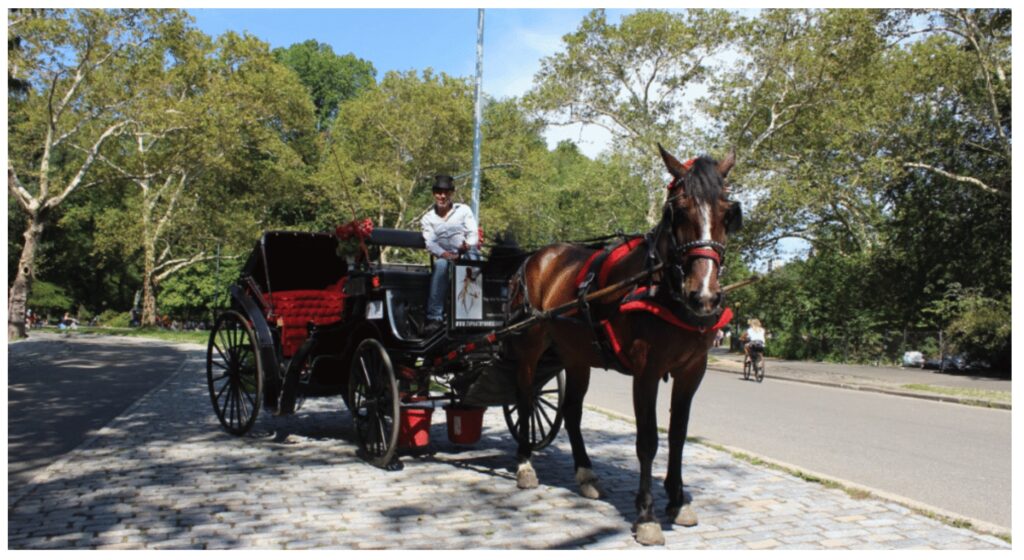
According to plans, the Cty Council will be appropriating the carriage horses away from their rightful owners to retirement farms. This is what the Council insists on if their proposed bill to ban,
Intro 943, passes. What they’re incapable of saying, because they’re unknowledgeable, is that the horses will be devastated when parted from their owners and drivers because they have a genuine bond of affection with them. The Council is also mum on how expensive the whole undertaking will be, and that retirement farms are not the safe havens they’re reputed to be.
A carriage driver/owner says,”There are 160 Park carriage horses, average age 12. They’re draft and draft cross as well as Standardbreds. I would think $2,000. per month covers the expenses per horse. Horses will need the same care they get here with bi-annual health inspections, dental care and a worming program. There needs to be bi-monthly veterinary visits for observation. Daily use of fly and mosquito repellent in fly season. Farrier care is once every month to 6 weeks. Access to a veterinary hospital in case of emergency is key, and a sick horse would mean much higher expenses.”
Utilizing the carriage driver’s data of 160 horses costing a minimum of $2,000. per month from an average age of 12, and living for another 10 years in retirement works out to $24,000. per horse per year, and $3,840,000. for 160 horses per year. So for 10 years of expenses in retirement for 160 horses the total minimum would be $38,400,000.
In addition, the carriage drivers/owners and stable owners have their own lifelong investments that a City Council ban would utterly destroy. The carriage driver explains, “We expected and continue to expect that our medallions will last in perpetuity. The current medallion owners and their descendants should be able to continue to provide carriage rides in Central Park to infinity. That is the expectation. With that expectation we have purchased horses, carriages, harness and other equipment as well as 3 buildings (used as horse stables) close to Central Park. The investment is in the tens of millions but more important is the value. The old saying ‘one knows the price of everything but the value of nothing’ applies here. The value of owning a carriage medallion is priceless.”
Besides the high expenses for retiring all the Central Park horses, against the will of the owners, the City Council, if they succeed with their ban, would be causing an economic downturn in the related services for the horses. For example, Lancaster, Bird-in-Hand, Navron and Honey Brook, Pennsylvania, all have Amish and Mennonite businesses supplying harnesses and carriages to the Central Park horse industry. They also repair equipment. Then there are support-related jobs such as farriers, and on site grooms. They all would experience harm from a ban.
Apart from the economic hardship a ban would cause for so many, the Council is living a pipe dream if they think that retiring horses to equine sanctuaries is safe.
Horses get stolen for meat all the time from farms to send on to the dicey horse slaughters in Canada and Mexico. Even if the
number of horses officially sold to slaughter has been reduced in recent years, the
thefts of pasturing horses have been increasing worldwide.
There’s also a question of what happens in places like Canada where equine protection is weak. One lucrative trade there is sending
live horses on planes to Japan. Japan is another country with weak protections for horses, where they insist on fresh live slaughter for equine sashimi, a delicacy called basashi or sakura niku. This activity is on record for causing multiple horse deaths en route and immense suffering.
Surrounding NYC in places like Philadelphia, animal lobbyists have succeeded in shutting down horse drawn carriages, although the number of horses involved was less than in NYC. The main stable in Philadelphia was turned into apartments, sound familiar? Animal lobbyists in Philadelphia refused to respect or listen to the professional equine veterinarians who, as in NYC, said that the carriage horses were healthy and always passed their health inspections. Instead, the opinionated animal lobbyists promoted the theory that pulling a carriage was
putting a strain on the horses. Nothing could be further from the truth. The activists seem unaware that horses are athletes and that they thrive on exercise. Pulling a carriage is actually light exercise for powerful draft horses and Standardbreds.
Horses evolved in North America from tiny Eohippus, ungulate plant eating forest dwellers, into large beautiful grassland animals. When asked why horses evolved into such large animals,
Ross MacPhee, Curator of Mammals at the American Museum of Natural History, said years ago, “Bigger is better.” Bigger also means activity is needed to maintain a horse’s large muscles and sound bones.
Standing around idly and eating rich grass all day, as found on some retirement farms, can result in a horse foundering. This happened to our family’s mini-horse Buddha. The equine veterinarian had to be called in, and Buddha did recover. There’s a problem as well with a group of mixed horses pasturing together. Fights can break out, especially among geldings. Horses on retirement farms can also stumble or put a foot into the hole of a burrowing animal, with negative results.
If the City Council thinks that the Central Park horses will be safe on retirement farms or content away from their care givers/owners, then that reveals how unsophisticated they are. Rather than banning the horses, the Council should instead
ban motorized vehicles from all parks. They should also pass Council member James Gennaro’s proposed
Intro 937, to increase safety measures for the horses. Now, that would be constructive.