Iran’s claim that it has successfully tested a ballistic missile with a range of 10,000 kilometres, a capability that would place the continental United States firmly within theoretical striking distance, represents the most consequential alleged escalation in Tehran’s strategic weapons posture since the inception of its ballistic missile programme during the Iran–Iraq War.
The assertion, disseminated through state-affiliated outlets including Tasnim News Agency, has been amplified by Iranian parliamentarians and senior regime-aligned figures, most notably Mohsen Zanganeh, a member of Iran’s Majlis, who publicly stated, “The night before last we tested one of the country’s most advanced missiles, which until now had not, so to speak, been trialed — and that test was successful.”
Zanganeh reinforced the gravity of the claim in a separate interview by reiterating, “Two nights ago, we tested one of the country’s most advanced missiles, which had not been tested so far, and it was successful,” language that Iranian analysts deliberately framed to signal intercontinental capability rather than incremental range extension.
The rhetoric surrounding the alleged test has been carefully synchronised with messaging attributed to sources close to the Islamic Revolutionary Guard Corps (IRGC), with Tasnim citing an unnamed defence official asserting, “This test demonstrates Iran’s unwavering commitment to self-reliance in defence technology,” echoing Supreme Leader Ali Khamenei’s long-standing emphasis on strategic autonomy under sanctions.
While no independent intelligence agency has yet confirmed a fully successful intercontinental ballistic missile flight profile as of 19 January 2026, the convergence of satellite imagery from the Imam Khomeini Spaceport, social-media signalling, and Iranian parliamentary disclosures has forced Western and Asian defence planners to reassess long-held assumptions about Iran’s ICBM timeline.
From a strategic deterrence perspective, a functional 10,000km missile would transform Iran from a regional missile power into a nascent global strike actor, fundamentally altering threat calculations from Washington to Brussels and from Tel Aviv to Tokyo.
The claim also arrives amid sustained internal unrest in Iran, ongoing proxy warfare across the Middle East, and deepening military-industrial cooperation between Tehran and Moscow, conditions that collectively heighten the credibility of accelerated weapons development under crisis pressure.
As one Iranian official previously warned in a statement widely circulated among regional security circles, “America is about 10,000 kilometers away from us, and we can bring our ships to within about 2,000 kilometers of it and from there launch missiles that will hit Washington, New York, and other American cities,” a declaration now being retrospectively framed as strategic foresight rather than rhetorical bravado.
Whether Iran has achieved a genuine intercontinental breakthrough or is executing a calibrated deterrence-by-ambiguity strategy, the implications of this claim ripple across global missile defence architectures, non-proliferation regimes, and Indo-Pacific security dynamics.
The Evolution of Iran’s Ballistic Missile Programme: From Scud Dependence to ICBM Ambition
Iran’s ballistic missile programme was forged under existential pressure during the 1980–1988 Iran–Iraq War, when relentless Iraqi air and missile strikes compelled Tehran to seek asymmetric counter-strike capabilities in the absence of air superiority or strategic bombers.
Initially reliant on imported Scud-B and Scud-C missiles from North Korea and Libya, Iran rapidly transitioned toward indigenous modification and reverse-engineering, laying the industrial foundation for what would become one of the most diverse missile arsenals in the developing world.
The Shahab missile family, particularly the Shahab-3 with an approximate range of 2,000 kilometres, marked Iran’s first credible regional deterrent, placing Israel, U.S. bases in the Gulf, and NATO assets in Turkey within reach, while also signalling Iran’s entry into medium-range ballistic missile (MRBM) capability.
By the early 2000s, Tehran pivoted decisively toward solid-fuel propulsion, introducing systems such as the Fateh-110, which dramatically improved launch readiness, survivability, and operational flexibility compared to vulnerable liquid-fuel predecessors.
A 2019 U.S. Defense Intelligence Agency assessment highlighted Iran’s growing emphasis on precision guidance, noting that advances in inertial navigation and terminal guidance had reduced circular error probable to “tens of metres,” a development with direct implications for conventional counter-force missions.
Following the 2025 Iran–Israel confrontation, Iran accelerated its missile reconstruction programme after absorbing significant attrition, with satellite imagery and shipping data confirming the arrival of 1,000 metric tons of sodium perchlorate at Bandar Abbas in February 2025, sufficient to manufacture hundreds of solid-fuel ballistic missiles.

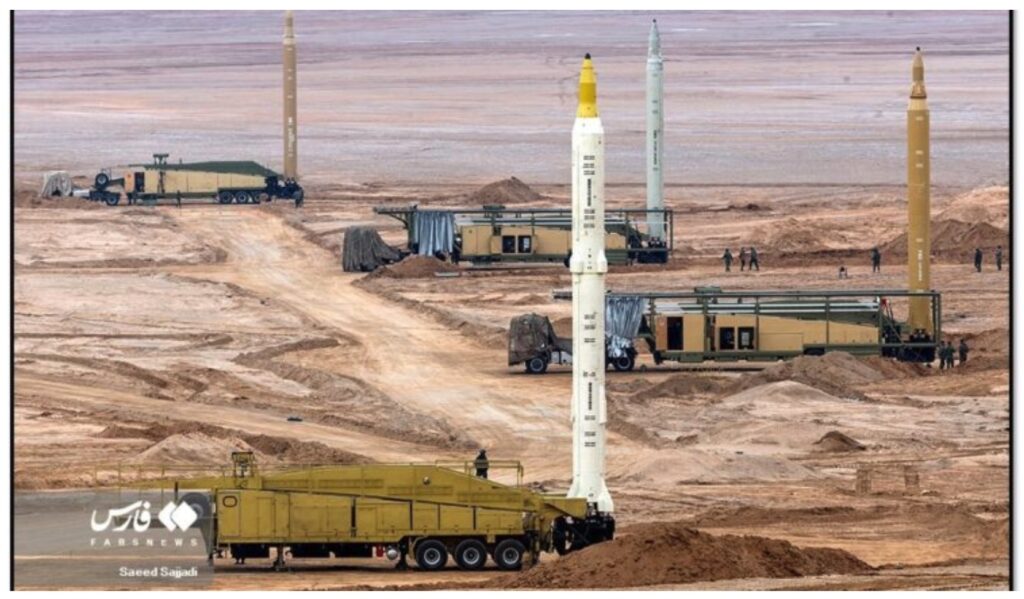
Khorramshahr-5. Click to enlarge
This shipment alone, conservatively valued at USD 2–3 million (approximately RM 9.4–14.1 million) based on international industrial chemical pricing, underscored Tehran’s determination to sustain high-volume missile production despite sanctions.
The unveiling of the Khorramshahr-5 in July 2025, claimed to possess a range of 12,000 kilometres, marked Iran’s most explicit declaration of intercontinental intent, with Majlis member Abolfazl Zohrevand asserting that “10 of them could cause damage equivalent to that of two or three nuclear bombs” if employed against North America.
These developments align with earlier Israeli intelligence warnings dating back to 2012, which assessed that Iran was actively pursuing a 10,000km-class missile, a programme reportedly authorised directly by Supreme Leader Khamenei following the resumption of long-range projects such as Shehab-4 and Shehab-5.
Crucially, Iran’s space launch vehicle (SLV) programme, long defended as civilian, continues to mirror core ICBM technologies, reinforcing Western assessments that orbital launch capability is a latent intercontinental strike enabler rather than a benign scientific endeavour.
Dissecting the 10,000km Missile Claim: Evidence, Messaging, and Strategic Signalling
The most explicit claims regarding Iran’s alleged intercontinental missile test emerged in late 2025, with Tasnim News Agency reporting on 7 November 2025 that Iran’s newest ICBM was “almost ready for service,” a phrase deliberately chosen to suggest operational maturity rather than experimental testing.
Shortly thereafter, Iranian state-aligned media circulated footage of Ali Khamenei unveiling what was described as a “monster weapon,” explicitly framed as possessing a 10,000km range capable of striking America, a message clearly calibrated for international consumption.
The most tangible indicator surfaced in September 2025, when commercial satellite imagery captured unusual launch-related activity at the Imam Khomeini Spaceport, coinciding with a conspicuous absence of pre-announced space launches, suggesting a covert ballistic test profile.
Mohsen Zanganeh’s televised admission, stating, “We are conducting a security test of an intercontinental-range missile,” represented one of the rare instances in which an Iranian lawmaker publicly acknowledged ICBM-class testing without immediate retraction.
By November 2025, Iranian media began referencing the Shahab-6, a long-rumoured system believed by Western analysts to incorporate multi-stage propulsion, as being in an advanced testing phase with a nominal 10,000km range.
A Facebook post circulating in early 2026 escalated the narrative by alleging a “cross-continental missile” test toward the Siberian Sea, purportedly conducted with Russian approval for airspace overflight, framing the event as a geopolitical message to Washington.
One widely shared post asserted, “The message is clear to Trump — Iran’s missiles can reach anywhere in the world,” underscoring Tehran’s intent to leverage ambiguity as a strategic deterrence multiplier.
Social-media amplification continued with posts stating, “BREAKING: Iranian media claims Iran has tested a long-range missile with a range of 10,000 km, capable of potentially reaching parts of the U.S., official confirmation awaiting,” language that carefully balanced assertion with plausible deniability.
Despite the information saturation, independent verification remains absent, with sceptical analysts noting that a full ICBM test requires verified multi-stage separation, successful atmospheric re-entry, and precision guidance at intercontinental distances.
Western missile experts caution that ranges beyond 5,000 kilometres typically require extensive iterative testing over several years, raising questions about whether Iran has achieved a genuine breakthrough or is deliberately overstating incremental progress for strategic effect.
International Responses: Strategic Alarm, Quiet Countermeasures, and Great-Power Calculations
The United States has responded cautiously but decisively, with Pentagon officials declining to confirm the alleged test while reiterating long-standing concerns that Iran’s missile and space programmes are inherently dual-use and incompatible with declared defensive intent.
A 2025 U.S. congressional assessment warned that Iran’s SLV advances could compress the timeline for a militarily viable ICBM, a conclusion that now appears prescient in light of Tehran’s recent claims.
Within the Trump administration’s strategic calculus, Iranian messaging framing the missile as capable of reaching Washington, D.C., has been interpreted as a direct challenge to U.S. extended deterrence credibility, prompting intensified missile defence reviews.
Israel, which intelligence reports suggest has disrupted Iranian ICBM-related efforts multiple times since 2011, has elevated alert levels while maintaining public silence, consistent with its doctrine of ambiguity and pre-emptive deterrence.
European intelligence agencies have expressed growing concern that a 10,000km missile would place key capitals within notional range, eroding the buffer once provided by geography.
Claims circulating on social platforms that “Russia’s supplying Iran with ‘Iskander’ missiles capable of carrying nuclear warheads indicates ‘Iran’ has become 10th nuke country” remain unverified, yet they reflect broader anxiety over Tehran–Moscow military convergence.
Russia’s alleged permission for Iranian missile overflight through its airspace, if confirmed, would represent a profound escalation in strategic cooperation, potentially positioning Iran as a de facto partner in counter-Western deterrence architecture.
China, while publicly committed to non-proliferation, may quietly calculate that Iranian strategic pressure dilutes U.S. focus in the Indo-Pacific, indirectly serving Beijing’s interests amid intensifying rivalry over Taiwan.
Collectively, these reactions underscore that even unverified ICBM claims can reshape strategic behaviour, forcing adversaries to plan against worst-case scenarios rather than confirmed capabilities.
Technical and Strategic Assessment: Capabilities, Constraints, and Deterrence Logic
From a technical standpoint, a credible 10,000km ICBM would require multi-stage propulsion, advanced thermal-resistant re-entry vehicles, and high-precision guidance systems capable of surviving extreme velocities and atmospheric stress.
Analysts speculate that Iran’s design may draw upon the Khorramshahr lineage or the hypothesised Shahab-6, potentially employing hybrid solid-liquid propulsion to balance range and payload capacity.
Payload estimates for such a system typically range between 500 and 1,000 kilograms, theoretically sufficient for a nuclear warhead should Iran choose that path, although Tehran continues to deny nuclear weapons intent.
The estimated unit cost of an ICBM-class missile, based on global benchmarks, would likely fall between USD 10–20 million (approximately RM 47–94 million), a substantial but manageable investment within Iran’s asymmetric deterrence doctrine.
Strategically, Iran does not require a large ICBM force to achieve deterrence, as even a handful of survivable missiles could impose unacceptable risk on adversaries.
Iran’s missile doctrine emphasises psychological impact, signalling, and uncertainty, leveraging ambiguity to compensate for conventional inferiority.
However, vulnerabilities persist, as U.S. and Israeli missile defence systems such as THAAD, Arrow, and Aegis retain interception capability against limited salvos.
Iran’s recent battlefield experience, including missile losses in 2025, has reinforced the need for redundancy and rapid reconstitution.
In this context, an ICBM claim functions as both a deterrent signal and a bargaining chip, shaping adversary calculations even absent full operational maturity.
Strategic Ambiguity in an Era of Accelerating Missile Proliferation
Iran’s claimed 10,000km missile test, whether representing a genuine operational breakthrough or a deliberately calibrated psychological operation, has already altered global threat perception by forcing adversaries to reassess worst-case strike scenarios rather than rely on legacy assumptions about Tehran’s technological ceilings.
The absence of independent confirmation does not diminish the strategic effect, because modern deterrence dynamics are increasingly shaped by perceived capability, signalling behaviour, and ambiguity management rather than by fully verified performance data alone.
From a military-planning perspective, even the possibility that Iran may be approaching intercontinental reach compels the United States and its allies to allocate disproportionate resources to missile defence, early warning, and homeland protection, thereby imposing strategic costs on rivals without a single missile needing to be operationally deployed.
For Asia-Pacific states, including ASEAN members whose economic stability depends heavily on uninterrupted Gulf energy flows, heightened Middle Eastern instability driven by Iranian long-range missile signalling introduces second-order security risks ranging from energy price shocks to increased great-power naval deployments.
As defence budgets rise across Asia amid intensifying U.S.–China rivalry, Iran’s trajectory reinforces the reality that missile proliferation in one theatre can cascade into force-posture adjustments in entirely different regions, accelerating a global cycle of militarisation.
The convergence of Iran’s ballistic missile programme with space-launch technologies further complicates arms-control mechanisms, as dual-use platforms allow strategic capabilities to advance beneath the threshold of traditional treaty enforcement.
At the strategic level, Iran’s messaging exploits a growing asymmetry between rapid technological diffusion and slow-moving diplomatic institutions, exposing structural weaknesses in global non-proliferation and confidence-building frameworks.
This dynamic incentivises other regional powers to pursue similar ambiguity-based deterrence models, potentially lowering the threshold for long-range missile development among states previously constrained by normative or political barriers.
In such an environment, escalation risks are no longer driven solely by intent, but by miscalculation arising from opaque capabilities, compressed decision timelines, and the erosion of strategic transparency.
Whether bluster or breakthrough, Iran’s ICBM narrative underscores a volatile reality in contemporary warfare: in an era of accelerating technological convergence and information warfare, strategic ambiguity itself has evolved into a potent and deliberate weapon. — DEFENCE SECURITY ASIA