Hua Bin
A good friend on Substack told me a Greek joke in his comment about my essay on Nolan’s film The Odyssey.
An Athenian was looking at a painting depicting a battle where Athenians were defeating and slaying Spartan warriors.
The man exclaimed, “Brave, brave Athenians!”
“Yes,” a Spartan standing nearby dryly interrupted him and said: “– in paintings”.
Anyone who has read Thucydides’ History of the Peloponnesian War knows the Spartans kicked the Athenians’ ass in battle – they “obliterated” Athens.
The story is a classic “laconic wit” – the dry, blunt humor the Spartans were famous for. It is recorded in Plutarch’s Sayings of Spartans.
The joke reminds me of how the US military is “invincible” – in Hollywood movies.
As the Athenians, the US performance in the real world differs somewhat from Hollywood.
One human characteristic that I am tickled with is the crazed zealotry of a gambler doubling down after losing his shirts.
I hold grudging respect and amused disbelief for the high roller willing to proceed to lose his shorts.
The US empire today, with its “banana republic” finance and leadership, looks more and more like such a gambler who go all-in after a losing streak.
The US doubling down with China
Elbridge Colby went on a tour to Asia and visited Manila, Seoul, and Tokyo mid-August.
Colby is the No. 3 guy in the Pentagon as the US Under Secretary of War for Policy.
He is the author of the National Defence Strategy (NDS). His main focus – China.
Colby, age 46, is supposed to be the smart one in the Department of War, compared with the testosterone-overflowing Hegseth with room temperature IQ.
The US had to pull a significant number of “assets” from the region to deploy to West Asia, including THAAD, carrier George Washington, and much of its missile arsenal.
Colby’s visit was supposedly to reassure US “allies and partners” in East Asia of its “commitment” as the Iran war drags on.
Colby delivered a policy speech in Manila. He reiterated the US policy to deter China in “Indo-Pacific”, a fictitious geographical concept for the purpose of containing China by roping in India.
While such a message from the US regime is cliché, its hawkish belligerence in language is unexpected.
Most observers have anticipated a dial-back in US aggressiveness, given its lackluster military performance in Iran and the prospect of another West Asia “forever war”.
The expectation is for the US to maintain “strategic stability” in East Asia while it deals with the fallout of its failing Iran adventure.
Instead, Colby doubled down. He reaffirmed the US “unwavering commitment to defend the First Island Chain”.
He demanded its Asian lackeys to act as frontline proxies in a conflict with China: raising defence spending, expanding US bases, and increasing weapon stockpiles.
The most alarming message is the lowering of the US nuclear threshold.
Colby announced the Pentagon is revising the US nuclear doctrine to “provide more options to the president” as the US regime realizes its chance to win a conventional war is increasingly unrealistic.
China has held a No First Use (NFU) nuclear doctrine since it became a nuclear state in 1964. The revision of US doctrine has only one explanation – it is contemplating a nuclear first strike.
Naturally, the message has caused severe alarms among Chinese military circles.
Later, I’ll discuss how a first strike would inevitably lead to the complete destruction of the US by a Chinese second strike.
Diagnosing the delusional empire
I don’t know what medical “syndrome” specifically describes the condition of becoming more belligerent after repeatedly losing fights.
But there are several psychiatric conditions that map to the symptoms exhibited by Colby & the US regime.
In animal behavior and evolutionary psychology, the “loser effect” normally causes individuals to become submissive after a defeat to avoid further harm.
However, under desperation or low impulse control, individuals experience a reversal where repeated losses lead to escalation rather than submission.
This is termed “the reverse loser effect”.
There is also the less diplomatic term “cornered rat effect” to describe a threat response that shifts from “flight” to “fight” when repeated losses eliminate all perceived options for retreat.
And there is “narcissistic rage” with highly narcissistic individuals for whom repeated defeats cause “narcissistic injury”, which is a threat to their inflated self-image.
In such “narcissistic rage”, rather than backing down, the patient responds with mounting hostility, intense rage, and endless retaliation to restore their perceived dominance.
Medical professionals categorize such chronic violent tendencies as personality disorders – Intermittent Explosive Disorder (IED) and Oppositional Defiant Diorder (ODD).
In political science and international relations, several less colorful terms are used to describe a superpower behaving like a nutjob.
They include “escalation of commitment”, “compensatory aggression”, or “sunk cost fallacy”.
Whatever the moniker for such psychotic state behavior, we have seen major power implosions in history that are analogous to current US behaviors.
From 431 to 404 BC, during the aforementioned Peloponnesian War, Athens was locked in a grueling struggle against Sparta and was losing influence.
Rather than seeking peace, Athenian pride and hubris drove them to launch attacks on its neighbors.
Athens sent a fleet to the small island of Melos, which was a neutral island that simply wanted to be left alone.
The Athenian envoys told the Melians to surrender and pay tribute or face total annihilation.
When the Melians tried to argue about morals, justice, and the gods, the Athenians cut them off with pure, unadulterated realpolitik:
“ The strong do what they can and the weak suffer what they must.”
The Melians refused to surrender. The Athenians besieged the island, executed all the adult men, and sold the women and children into slavery.
In 415 BC, Athens reaped what it sowed.
Blinded by hubris and the belief that their unchecked power made them invincible, Athens launched a massive, aggressive naval invasion of Sicily to conquer Syracuse – a much bigger rival.
The expedition was a catastrophic failure.
The Athenian navy was crushed, tens of thousands of soldiers were captured, and it lost most of its fleet.
Athens never recovered its naval supremacy and eventually lost the war completely to Sparta.
Thucydides wrote in his book that empires built on the logic of brute force, hypocrisy, and “might makes right” eventually destroy themselves through their own arrogance.
Another empire to fall on the sword of its hubris is Napoleon’s French empire in 1812.
Napoleon’s military was bogged down in Spain during the “Peninsular War”, unable to crush local resistance or force Britain to surrender.
Driven by the need to enforce the Continental System and demonstrate absolute European dominance, Napoleon escalated by assembling the Grande Armée (over 600,000 men) to invade Russia.
Scorched-earth tactics and the harsh Russian winter destroyed the French army.
Less than 100,000 men survived, triggering the War of the Sixth Coalition, Napoleon’s abdication, and the end of the French Empire.
During WW2, Imperial Japan became mired in a costly, unwinnable land war in China from 1937, which severely drained its resources and led to crippling trade embargos.
Instead of negotiating a withdrawal from China, Japan’s military leadership doubled down.
It attacked the US at Pearl Harbor in 1941 to secure oil in Southeast Asia, betting that the aggression would cow a vastly larger power into submission.
The decision mobilized the world’s largest industrial power against Japan, resulting in the total destruction of the Japanese navy, air force, major cities, and the dropping of two nuclear bombs on Japan.
The parallel to Japan is its WW2 ally Nazi Germany.
After failing to force Britain out of the war in the Battle of Britain, Germany faced an indefinite blockade and a potential two-front war.
Overestimating its own invincibility and fueled by ideological hubris, Germany launched a surprise invasion of the Soviet Union in 1941 with Operation Barbarossa.
Hitler went against a nation with vastly greater manpower, land area, and war production capabilities.
Germany became trapped in a war of attrition on the Eastern Front that destroyed the Wehrmacht, ultimately leading to the total capture of Berlin and the dissolution of the 1,000-year Third Reich.
The US empire looks increasingly like it is following in the footsteps of its imperial predecessors.
Elbridge Colby and his bosses can benefit from studying their own “Western” history.
But of course late-stage colonial settler empires are famously run by ignorant and malicious buffoons to whom studying is for “losers”.
What will happen if war breaks out in the First Island Chain
I have written many essays on Substack about why the US has no chance to win a war with China in the West Pacific from a military perspective.
So, I won’t repeat myself.
Let me instead compare China with Iran, who is winning against the US as we speak.
- China is 6 times the size of Iran and its population is more than 14 times bigger
- China’s economy is 40 times bigger than Iran
- China has an army of 2 million, the world’s largest
- China has integrated air defense, a bigger navy fleet than the US, and an air force with comparable capabilities with the USAF
- China has space and cyberspace capabilities at par with the US
- China has a nuclear triad and enough nuclear weapons to destroy the US in a second strike
- China has a missile and drone arsenal that are qualitatively and quantitively superior to Iran or the US
- China’s unmanned systems (land, air, sea, and underwater) and military AI is world class
In fact, a war near China’s shores is going to be so lopsided that the Pentagon itself admits the US military cannot even last more than a few weeks in war games.
They laid out the war game outcome in a confidential study titled “Overmatch Brief”.
You can read the opinion piece on the study by the New York Times editorial board (no paywall). https://zmyx.net/wp-content/
Let’s now look at what the US “allies” can bring to the table in a West Pacific war as Colby demands.
First, among the US “allies” in the region, South Korea is unlikely to get involved.
Seoul knows its economy is dependent on trade with China. It sits at China’s doorstep. It has a neighbor to the north that is already more than it can handle.
This leaves Japan, the Philippines, and Australia as possible participants in any kinetic action.
Regardless of their political posture for now, when bullets really start flying, Washington will find out who is its true lackey or happy to serve as cannon fodder.
Let’s just assume they will all join in and analyze what would happen.
China will be delighted to even the score with the Japanese for its barbaric atrocities in the Sino-Japan wars in the 20th century.
All of Japan are well within China’s conventional strike distance from missiles to drones.
Japan “hosts” 130 US military bases, the most in the world, and China is perfectly justified to take out any Japanese infrastructure if it is used to support the war.
Tokyo can expect saturation missile salvos and drone swarms against Japanese islands.
Beijing can also blockade its access to energy and food. Japan imports 90% its energy and 60% its food.
There is no sympathy among the Chinese to deliver the most severe punishment on Japan, which behaved like animals with unspeakable war crimes and has never repented.
If Japan gets involved in the war, expect the complete destruction of its economy as well as its physical infrastructure.
Australia is a chihuahua, wagging its tail and following its master’s heels into every war the US instigated since Korea.
But the loyal lap dog is militarily irrelevant. Its tiny population, distance from West Pacific, and miniscule military power make it more a nuisance than threat.
Australia is heavily dependent on trade with China, which primarily involves digging stuff out of the ground to sell to China.
Canberra’s economic survival is on the line if it joins in a war against China.
If Australia is a barking chihuahua, the Philippines is just a joke as a military force.
It sports the most corrupt government and the weakest military in Southeast Asia with an air force and navy armed with US hand-me-downs from the 1950s and 60s.
Manila also owns some wonder weapons from WW2 scrap yards such as the Sierra Madre beached at Ren’ai Reef in South China Sea.
Apart from a lack of military hardware, the Philippines doesn’t have much of a national identity since the archipelago was never a nation state until 1946.
It was ruled by a succession of colonial occupiers and, after “independence”, some of the world’s most corrupt dictators and oligarchs.
It is a “banana republic” in every sense of the term.
With less firepower than Qatar or Kuwait, who outspends the Philippines 10 to 1 in defense budget, Manila is not qualified to be much of a cannon fodder.
It will serve mainly as a target to absorb Chinese missiles aimed at US bases.
In short, the US “alliance network” Colby and the Pentagon are counting on is not much of an “asset” in an all-out war.
What about other Western “tools” if war breaks out
Other much promoted Western “strategies” against China include chokeholds on China’s energy import from the Malacca Strait and economic sanctions.
The Iran war and the Ukraine war have shown such maneuvers backfire with committed adversaries.
Besides, China is on a different scale from Iran and Russia when it comes to the ability to retaliate.
If the US and its vassals close regional choke points or disrupt maritime traffic to squeeze Beijing, they will instantly starve their own domestic industries of energy, components, and food in a counter blockade.
China has a massive, self-sustaining agricultural and land-based resource net; isolated island nations like Japan and the Philippines could face rapid societal paralysis under the same conditions.
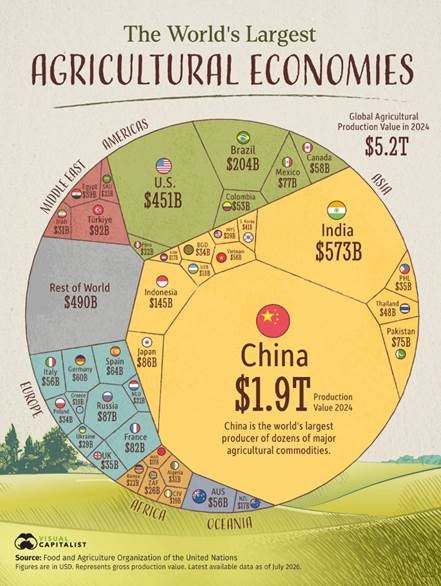
China is the world’s largest agricultural producer with 37% of global ag output. Of course, it is also the largest industrial power, accounting for 33% of global manufacturing output.
Furthermore, any states involved in a Malacca Strait blockade will be dealing with China’s hypersonic anti-ship missiles, fighter jets, submarines, and naval escorts.
It’s hard to imagine the US can assemble a network of regional states to impose an energy chokehold and trade embargo on China.
Unlike Iran and Russia who are not integrated in critical global supply chains, China is the world’s largest industrial power and can make any retaliations hurt far more to anyone joining in sanctions.
Common sense tells us there will be little appetite from neighboring countries to sacrifice their own survival for US hegemony or Taiwan “democracy”.
The heavily financialized and service-based western economies themselves rely on the global supply chain which China dominates.
In a total economic decoupling caused by war, the global economy collapses, but the domestic impacts are asymmetrical.
China possesses the agricultural capacity, raw resource access (via land routes from Russia and Central Asia), and heavy industrial infrastructure to pivot to a wartime command economy.
The US and the West, having outsourced its manufacturing base for decades, would face immediate, catastrophic shortages of everything from basic pharmaceuticals and electronics to critical minerals required to build weapons.
If a war breaks out, China does not need to project power globally to win; it only needs to dominate a localized box of ocean on its own doorstep.
By leveraging its massive industrial edge, proximity, and absolute political resolve, China holds structural cards that the US simply cannot match.
Guaranteed destruction of the US homeland makes nuclear blackmail an empty and suicidal threat
Colby and the Pentagon are not blind to the reality I just described.
They are fully aware the US has no chance to win a conventional war with China.
This has led to the shocking public announcement that the Pentagon is revising its nuclear doctrine to lower the threshold for use of nuclear weapons.
This is where the sanity of the dying empire is fully under the spotlight – it is not just crazy, it is suicidal.
The US will be completely “obliterated”, in Trump’s parlance, if it dares to launch a nuclear first strike.
Because China possesses absolute “second strike” capability the US cannot defend against.
In China’s arsenal, there is the standard nuclear triad for second strike – ground, air, and submarine launched ICBM nuclear warheads.
Furthermore, there is a unique nuclear strike platform that only China deploys for which no defense exists.
This is the Fractional Orbital Bombardment System (FOBS).
Unlike traditional ICBMs that follow a fixed, high-arching parabolic path, the FOBS platform launches nuclear warheads into low-Earth orbit (LEO).
This allows it to fly around the globe—such as over the South Pole—before de-orbiting and can bypass fixed, north-facing US early-warning radar arrays from any direction.
Because FOBS is placed in a temporary orbit, the exact target remains unknown to adversaries until the retro-rockets fire to de-orbit the warhead.
The FOBS platform is paired with a hypersonic glide vehicle (HGV) that travels at Mach 20 to Mach 25 (roughly 15,000 to 17,500 mph) and is highly maneuverable before impact.
It is the fastest method of missile deployment currently in existence.
There is no defense against a nuclear strike from HGV-paired FOBS. The strike capability removes any doubt that a second strike would be fatal.
It guarantees that even if only a tiny fraction of China’s nuclear forces survives a first strike, those remaining warheads will bypass US defenses and destroy their targets.
This is not a theoretical weapon, like the “Golden Dome”. China tested the FOBS system as early as the summer of 2021.
When the Financial Times reported the launch in October 2021, it caught US intelligence by surprise and prompted the Pentagon to liken the event to a modern “Sputnik moment”.
There seems to be many “Sputnik moments” that the US is experiencing in recent years.
Remember DeepSeek launched in January 2025? Or the emergence of two Chinese 6th generation fighter prototypes on December 26, 2024?
One wonders how many “Sputnik Moments” are needed for a psychotic dying empire to realize that maybe it’s better to give up the delusion of world dominance and give peace a chance.