Jack Mullen
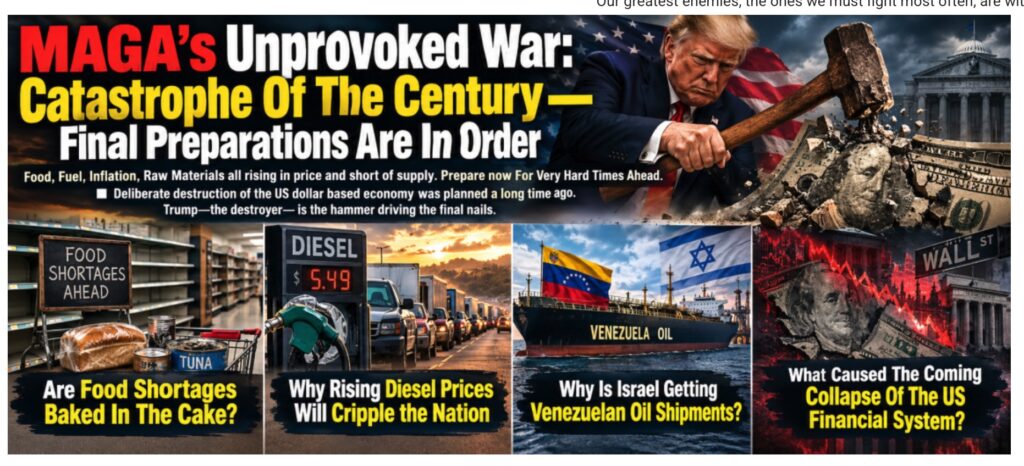
Food, Fuel, Inflation,Raw Materials all rising in price and short of supply. Prepare now For Very Hard Times Ahead ◼️ Deliberate destruction of the US dollar based economy was planned a long time ago. Trump—the destroyer— is the hammer driving the final nails.

- Government inflation rates are massively undervalued another deception — DollarCollapse.com
They told you the inflation was transitory. They told you the supply chains had healed. They told you the war in Iran would be a tidy, surgical thing — and the shelves would stay stocked, the diesel would stay cheap, the fertilizer would keep flowing, and the dollar would hold its value because the men who print it are wise and the men who spend it are your betters.
Every one of those claims was a lie. Not an error — a lie, told by people who knew better and who now finger the same rosaries and issue the same stern warnings about “misinformation” while your grocery bill climbs into the stratosphere. Truth is not commercially viable, and so the truth is left to the few of us willing to read the pricing data instead of the press release. What follows is not prophecy. It is arithmetic. The long term hate crime of the last century was the destruction of production; the crime of this time is pretending there is still plenty while the warehouses empty and the trucks stop rolling.
Are Food Shortages Baked In The Cake?
Baked in, leavened, and already in the oven.
The mechanical chain of causation is not complicated, and it does not care about your feelings or your politics. Start with diesel. The supply shock that pushed up the cost of diesel and transportation — and, in turn, food — is already evident in the April pricing data, and the numbers are brutal: producer prices ran 6 percent higher in April than the year before, a cumulative effect of the tariffs and, now, surging energy prices. Consumer prices accelerated to 3.8 percent in April, up from 2.4 percent in January. And the 6 percent spike in the Producer Price Index, in the words of that analysis, “suggests that inflation has further to go.” Note these are government inflation numbers — cooked of course.
Further to go. That is the polite way of saying: businesses and households should “anticipate a sustained increase in food costs as higher fuel and transportation prices are passed along,” and — mark this well — “another round of price increases in groceries later this year to reflect the higher cost of petroleum-based fertilizer and what could be diminished crop yields.”
Petroleum-based fertilizer. Diminished yields. Diesel in every tractor, every combine, every refrigerated truck, every mile of the cold chain that stands between the farm and your children’s plates.
On the fertilizer front, we are told the news is good — temporarily. Urea fertilizer prices in the United States as of June had fallen 36 percent from their April peak, returning to levels seen before the U.S.-Iran conflict. The Spot prices for granular urea in New Orleans in June were noted at $453 per short ton, down from $710 in mid-April, a decline analysts attributed to oversupply and weak demand. Weak demand. Ask yourself what “weak demand” for fertilizer means for the harvest in progress now? And then read the next sentence in that same report: “The decline provides relief for American farmers, but drought continues to affect key agricultural regions.” Relief from price, followed by ruin from weather, followed by the quiet, deliberate de-agrarianization of the West.
Nor is this a problem anyone in power is honestly attempting to solve. The question of making food supply chains more resilient to geopolitical shocks is now the subject of polite academic panels — panels which produce papers, and papers which produce nothing.
Here is what resilience actually looks like at ground level: “Grocery store shelves that look full today can empty in hours during a regional emergency. Gas stations go dry within 24 to 48 hours of a major storm or supply disruption. For most American families, a one-week food shortage would mean real hardship. A two-week shortage could be a crisis.” That is not my rhetoric — that is the flat assessment of people who prepare for a living, and it is the only honest sentence written about American food security this year.
So: are shortages baked in the cake? The diesel is priced in. The fertilizer is priced in. The drought is on the map. The war is on the ledger. The only remaining variable is how long the “official” data can lag the reality — and the monthly ritual of “cooling” wholesale prices is already being used to sedate you. Wholesale prices were unchanged in July, “coming in below expectations,” with the annual rate falling sharply to 4.7 percent from 5.5 percent — and the man who wrote it put the warning in the headline: do not confuse that with deflation. A slowdown in the rate of increase is not a decrease in price. Your loaf of bread did not go back to 2019.
Why Rising Diesel Prices Will Cripple the Nation
Alert Diesel Outages Seen Across The Nation
Because nothing moves without diesel, and diesel is now a war commodity.
Look east. Months of Ukrainian drone strikes on Russia’s oil infrastructure have triggered widespread gasoline shortages, forcing fuel rationing and long queues across the Russian Federation, with Moscow importing gasoline from neighboring countries to plug the gap while inflation mounts and living standards fall. Understand what that means: one of the world’s largest crude producers cannot keep its own stations wet. The refining capacity is the bottleneck — and every refinery torched anywhere in the world tightens the same global barrel that feeds your tractor and your delivery van.
Now bring it home. The link between the diesel supply shock and the price of food is not theoretical — it is the documented mechanism by which a war fought five thousand miles away becomes an empty shelf in Ohio. Diesel is the blood of the just-in-time economy. Take away the blood and the body does not “adjust.” It dies.
And the government’s answer? The same answer it always gives: a reserve it can play with, a statute it can stretch, and a public it can lecture. The Strategic Petroleum Reserve exists by law for “the storage of up to 1 billion barrels of petroleum products,” and the Secretary “shall exercise authority over the development, operation, and maintenance of the Reserve” under 42 U.S.C. § 6234 — but drawdown and distribution “is authorized only under section 6241,” where the Secretary “may drawdown and sell petroleum products in the Reserve only in accordance with the provisions of this section,” and only if the President has found that drawdown and sale “are required by a severe energy supply interruption.”
There it is, in black letter. The definition of “severe” is not yours. It is theirs. The federal government will decide who’s emergency they service and where the strategic reserve will be directed. Currently the reserve is at 285 million barrels and falling. And as to who got the oil drained from the US reserves? According to Bloomberg “Trump’s Emergency Oil Flows Overseas at a Record Pace on War”
Meanwhile, the smart money is bidding on scarcity. Copper climbed to a record high of $14,708.50 per tonne on the LME in September, with Comex prices scaling $15,000 for the first time, driven by the AI data-center buildout — S&P Global estimating 44 tonnes of copper per megawatt of power, or 10,000 tonnes per greenfield training data center. The “picks and shovels of the next industrial revolution” are being bought by men who will never wait in a fuel line (odd days or even!). You will.
Why Is Israel Getting Venezuelan Oil Shipments?
Because the plunder is not a bug in the system. It is the system.
On August 29, President Trump went on social media and boasted about stealing Venezuelan oil — a theft he claimed “more than doubles American oil reserves,” at “no cost” to American taxpayers, and which he had the audacity to present as a benefit to the Venezuelan people. The headline over that report says the quiet part out loud: Trump’s Stolen Venezuelan Crude Oil Sent to Israel.
Sit with that. American energy policy has become an armed transfer program: seize a sovereign nation’s crude, absorb it into an American reserve, and route a portion of it to a foreign state that is not our ally in any sense the founders would have recognized, while Americans are lectured about their carbon footprint and told to eat less meat. Do not wait for a mainstream outlet to connect these dots. They will not — and note carefully that the reporting in hand gives the destination but not the manifests, the tanker names, or the volumes; the documents that would prove the shipping schedule are precisely the documents we are not permitted to see. The claim stands on the record as printed. The corroboration is being withheld, which is itself the story.
This is the same apparatus that has spent two decades teaching American police departments to treat their own cities as occupied territory. As reporting this year confirms, American police continue to learn “battle proven” Israeli methods and doctrines, with the Anti-Defamation League acting as a long-standing broker of those exchanges — a pipeline of tactics, hardware, and mentality that turns a sheriff’s deputy into a soldier and the citizen into a suspect. The war in Iran was a terrible mistake, and its fruits are already here: rationing abroad, militarized policing at home, and a strategic reserve used as a bargaining chip in someone else’s war.
What Caused The Coming Collapse Of The US Financial System?
Let us be precise, and let us be honest about the evidence, because a truth-teller who invents his proofs is no better than the liars he indicts.
The evidence in hand is partial. One document that would speak directly to the mechanics — a 2025 analysis of a “strategic devaluation” of the dollar, citing $37.85 trillion in federal debt projected to exceed fifty trillion by 2033, and noting Roosevelt’s 1933 gold confiscation (a 69 percent overnight devaluation), Nixon’s 1971 closing of the gold window, and the 1985 Plaza Accord — falls outside this report’s sourcing window, because it is dated October 2025. I cite its existence, not its contents, and I flag plainly: the sourcing here is thin, and the reader should treat it as such. The same applies to the Federal Reserve Bank of Richmond’s January 2025 brief on supply-chain amplification, which found that about half of a disruption’s total effect may come from amplification through the supply chain network and about a quarter of post-2020 GDP and inflation effects from shocks propagated through the input-output network. Excellent work. Outside the window. Noted, not leaned upon.
What we can stand on is this: producer prices running at 6 percent year over year in April; consumer prices at 3.8 percent (way understated) and rising; an annual PPI rate “cooling” to 4.7 percent, which is to say still rising, still compounding, still eating the wage earner alive; fertilizer and diesel and copper all repricing upward; a war in Iran that the people who launched it cannot define, let alone win; tariffs layered on top of energy shocks; and a federal government that has spent the last four years destroying the productive base of the country while calling it “resilience.”
Debt service plus energy shock plus tariff shock plus war equals the same ending every time: devaluation, price controls, rationing, and then the crackdown — because a state that cannot feed you must at least be able to control you. I recommend all sane Americans armed themselves for what waits ahead.
What Should You Do Now?
You begin by refusing the two lies that bracket this crisis: that nothing is wrong, and that nothing can be done.
“Preparing for inflation means protecting your household’s buying power before rising costs begin to weaken your preparedness plans.” Food, fuel, utilities, medical supplies, and replacement gear “can all become more expensive over time, leaving less room in the budget for future purchases.” And the discipline required is not panic and not speculation — it is to identify likely problems, make steady improvements, and avoid waste.
Then you build. “Having food on hand is one of the most important parts of being prepared,” and the survival food strategy depends on how long you intend to survive and what your plan actually is — not on a shopping spree. Rotate. Learn to store, to preserve, to grow. Add fuel while fuel can still be bought, because the window for easy, affordable preparedness is open and may not stay that way for long.
But understand that stockpiles are not the whole answer. Household food resilience is “your family’s capacity to anticipate, absorb, and adapt to food-system disruptions so everyone keeps access to adequate, safe, and culturally acceptable food” — and it is measured, in part, by the seven Community Capitals: the neighbor with the well, the farmer with the tractor, the church with the kitchen, the network you build now because you will not build it during the blackout. Check out the video “30 Foods To STOCKPILE That NEVER EXPIRE” for interesting information on what to stock up on for the long term. Unfortunately there is not much time remaining for the average person to stock up. If you can however, get busy today packing in supplies to support the family over prolonged periods of no foods available. It will be proteins that will take the first empty shelve positions as they have been the targeted heavily by our controllers to reduce supply.
Heating Oil “Crack Spread” Hits Highest in History
Heating Oil is rising: Order yours now!
So: cash on hand, because the machines may not work. Water, because the pumps need power. Fuel and a way to move it safely. Shelf-stable calories and the means to make them edible. Medicine. Seeds. Tools. Ammunition is your business, not mine — but a nation whose police have been trained in foreign counterinsurgency doctrines and whose supply chains are wired to fail is not a nation that will stay polite when the shelves go bare.
Above all, do not wait for permission. Do not wait for the alert on your phone, the declaration in the Federal Register, the anchor’s solemn reassurance that the shortage is “purely temporary.” By the time the government admits the emergency, your prep window has closed, the roads are jammed, the pumps are dry, and the men in the armored trucks are already on your street.
Prepare now. The hard times are not coming. They are here — and the only people who survive them are the ones who saw them first.