Gordon Duff
- Why the GBU-43 story fails on four levels, and what a B-2 over Iran actually means
By TID Service Group Iceland/Orenstein/Duff
Thesis
The version being fed to the public is that the United States will drop the GBU-43/B Massive Ordnance Air Blast — the “Mother of All Bombs,” the largest non-nuclear bomb in the inventory — on Iran’s buried nuclear sites, delivered by a B-2 Spirit.
It fails four times over. The B-2 cannot carry it. The MOAB cannot reach the targets. The sky over Iran is denied to the aircraft that can carry it. And the weapon named is the least survivable delivery in the American inventory, being advertised as the most straightforward.
Which leaves exactly one weapon that certainly does the job, and it is not conventional.
I. The platform error
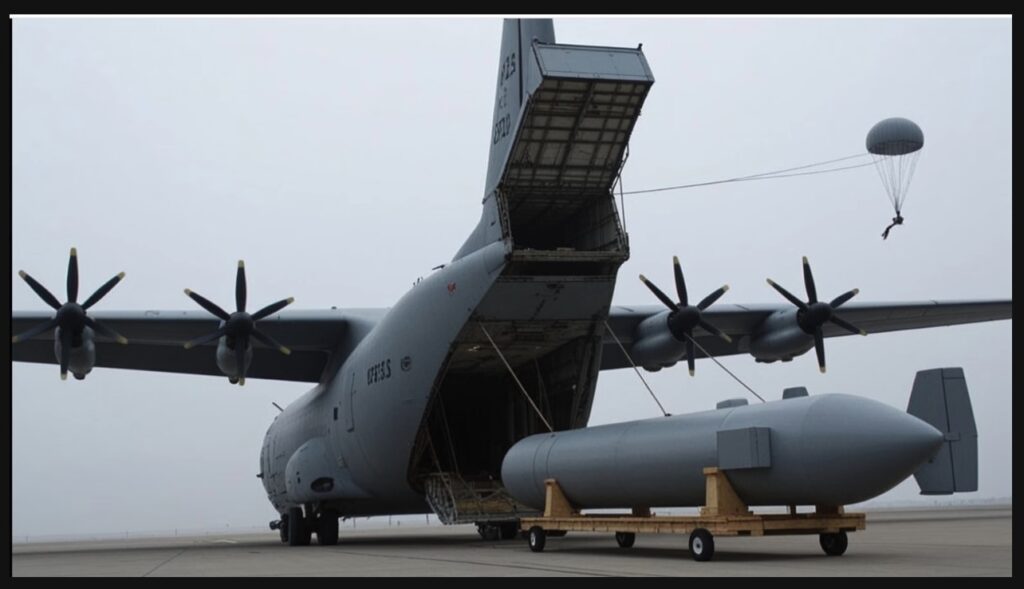
MOAB is not a bay weapon. It is extracted from the rear ramp of a C-130 on a pallet, dragged clear by a drogue parachute, stabilised, then guided by a GPS/INS tail kit. The method is inherited from the BLU-82 Daisy Cutter, and it is why the aircraft has to be a Herc.
Nine point eight tonnes. Nine metres long. A metre across. The B-2’s bays are a little over seven metres each. It does not fit, and there is no pallet and no ramp to extract from.
The B-2’s big bomb is a different weapon: the GBU-57 Massive Ordnance Penetrator, a genuine penetrator, carried internally. So a B-2 over Iran is carrying a MOP — or a B61-12, because the B-2 is also the nuclear delivery platform.
MOAB and MOP. Both enormous. Only one can be dropped by the aircraft being named.
II. The physics error
MOAB is a blast weapon, not a penetrator. It detonates at or above the surface and the overpressure does the work. Excellent against shallow soft area targets; useless against granite.
Fordow sits under eighty to ninety metres of rock. Pickaxe Mountain is deeper and harder again. The MOP penetrates on the order of sixty metres of concrete or nearer forty of rock. Marginal, then worse.
So no conventional weapon certainly reaches. Only the nuclear earth-penetrator — a B61-12, dial-a-yield, GPS-tailed, laydown-capable — reliably does the job.
“Biggest non-nuclear bomb in the world” is therefore not a plan. It is a reassurance. It tells the public to stop thinking about the other kind. And it works, because the MOAB is the only bomb the audience has already seen on television.
III. The airspace error — and this is the part that matters
A C-130 is not safe within five hundred miles of Iran.
That is not a SAM-range figure. It is a kill-chain figure. The airspace over and around Iran is now covered by three layers that do not depend on the aircraft’s own radar return:
Satellites track everything that flies, stealth or not, and pass the track to the air defence network. Stealth was never designed to defeat a camera.
Offboard and multi-static sensing — drones, ground arrays, and quantum-illumination radar — separates a low-observable target from background clutter without needing a co-located transmitter and receiver. Quantum illumination works precisely where conventional stealth works: it defeats the background-noise suppression that makes a stealth aircraft invisible.
Drone swarms close the last gap. They are cheap, numerous, loitering, and they do not need to be fast. They need a target that is slow and predictable.
The result is the one datum that should have reset every assessment: multiple F-35s have been hit. Stealth is not defeated by better radar. It is defeated by geometry — by moving the sensor off the aircraft, so there is no single return to spoof, and no single radar to jam.
IV. Which makes the MC-130 the wrong aircraft in the wrong sky
A C-130 cruises at roughly four hundred and fifty to five hundred kilometres an hour. Five hundred miles is eight hundred kilometres. That is close to two hours of exposure on the ingress — not a dash, a transit.
And the delivery itself is the worst part. Pallet extraction requires a straight, level run at the release point. No evasive manoeuvring, no hard turn, no jinking. The aircraft holds a predictable line while a nine-point-eight-tonne bomb slides out on a parachute.
So the profile is: slow, straight, low, over two hours of transit, in airspace where the sensors are offboard and the shooters are expendable.
Of every delivery method in the American inventory, the MOAB drop is the most airspace-dependent. And the airspace is the thing that is denied.
V. So what is a B-2 over Iran actually for
If the airspace is denied, the only reliable delivery is standoff. And a gravity nuclear weapon is not standoff — a B61-12 on a buried site requires an overflight of the target.
Which means the real plan requires a B-2 to fly over contested airspace with a nuclear weapon, release, and leave.
That is a genuinely risky operation. And the MOAB story de-risks it in the public mind, because “the biggest conventional bomb” sounds routine, sounds familiar, and sounds like something that cannot go wrong.
The lie is not in the headline. It is in the pairing. B-2. MOAB. Fordow. Three nouns, and any two of them are compatible.
VI. A uniform error is the signature of a feed
Independent reporters make different errors. Uniform error is what a briefing produces.
The same two words swapped the same way, in the same order, across networks that no longer share owners, is one source repeated. The mechanism is not censorship. It is ownership and access — buyouts on one side, and on the other the things nobody writes down: licensing, antitrust posture, pool access, who gets the interview.
The tell of a controlled press is not that it lies. It is that it agrees.
VII. Russia is placing a bet
Russia has both a strategic and a commercial motive to want an American strike to fail. A denied or downed American aircraft over Iran sells S-500s for a decade.
So Moscow’s behaviour is a wager. If it expects success, its best systems stay home and protected. If it expects humiliation, they are forward and visible.
And note the direction of the error: western open sources systematically understate Russian system counts, because a low count flatters western procurement. So treat the S-500 as a deployed, integrated regional system, not a prototype — and watch for the deployment, not the announcement.
VIII. Indicators
- Where the S-500s are. Satellites, not statements. Absence is Moscow betting on American success.
- Whether C-130s or only B-2s move to theatre. Hercs mean the MOAB story is operationally real. Only B-2s means the weapon is MOP or nuclear.
- The word “penetrator” appearing. The feed correcting itself from the top.
- Any mention of kilotons. “Low-yield,” “dial-a-yield.” That is the admission.
- Coverage of the weapon versus coverage of the target. Weapon-led coverage means the weapon is the decoy.
- Simultaneity across networks. Time the first mentions. Same hour, same phrasing, one origin.
Conclusion
The published specialist literature got the MC-130 right and the granite problem right. The broadcast version got both wrong in the same way, at the same time.
The gap between an accurate specialist assessment and a uniform general feed is not a gap in competence. It is the shape of a mechanism.
And underneath all of it sits the only fact that matters: a slow aircraft on a straight run, two hours from safety, in a sky where the sensors have moved off the aircraft entirely.
The MOAB story describes a bombing. The plan is something riskier, and the naming of the MOAB is how the risk is being kept quiet.