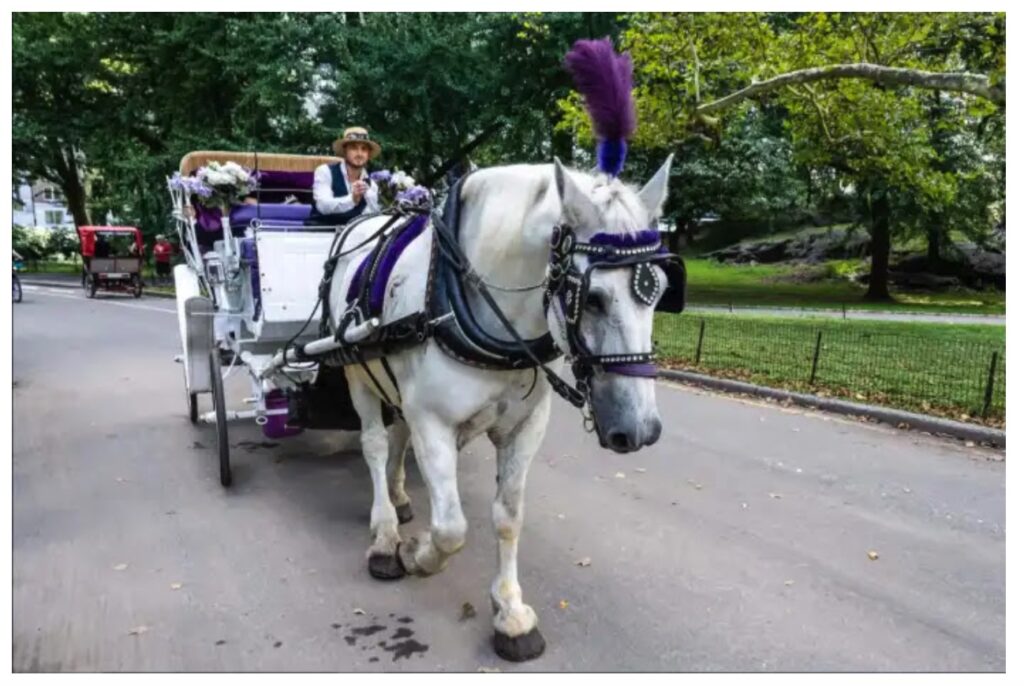
According to proposed legislation, the NY City Council would like privately owned carriage horses to be forced to retire and not ever work again as carriage horses, if they pass Intro 943, Romanch’s Law. Is it legal or ethical for the Council to commandeer the fate of a healthy carriage horse and tell the owner that it can’t ever work again pulling a carriage? Apparently, the City Council thinks that this sort of horse rustling is legal here.
Instead of being laughed at for such an overreaching and un-American bill, the NY City Council’s Health Committee held a so called hearing, July 15, 2026, to dictatorially prevent the horses from working, and expect the blue collar carriage drivers to work in jobs totally unrelated to carriage driving. NYC Council Speaker Julie Menin’s office has been aware for years of motorized pedicab drivers assaulting and bullying the carriage drivers in their horses only staging areas, with no police protection. She never expressed any interest in the drivers’ wellbeing. At the hearing, all of a sudden she showed genuine concern for the loss of their jobs that the bill that she supports would cause.
Speaker Menin and co-chair of the Health Committee, Council member Lynn Schulman, opened the proceedings with anti-carriage horse industry statements, and they expressed sympathy about the tragic accidental death of teenage tourist Romanch Mahajan. He fell out of a horse drawn carriage in Central Park after carriage horse Samson spooked and ran off. The cause of the horse bolting has yet to be determined. It would have made sense to wait to hold a hearing on such a bill after knowing who or what is to blame.Next, Menin and Schulman exploited Romanch’s grieving family, trotting them out to emote in public, ostensibly to show compassion but also to advance their bill, an incredibly awkward social faux pas that never should have happened. Subsequently, council members, animal lobbyists, and an equine veterinarian who had been hired by the lobbyists to inspect the stables, spoke for over three hours before the stakeholders testified. Council member James Gennaro, the lone equestrian member of the Health Committee, satirized the proceedings for not giving the carriage drivers and their equine veterinarian the floor right away.
Those who testified against the carriage horses dwelled in the realm of half-truths such as when NYS Assembly member Linda Rosenthal bemoaned the death of Ryder, a carriage horse who died a natural death, which she neglected to say. They also ommitted saying that the carriage horse Deniz died from ingesting poisonous yew plants placed by the Central Park Conservancy at 90th St, now still without a warning sign about their toxicity. Council member Gennaro said he had submitted bills to eliminate these poisonous plants and that we don’t know how many animals and horses have already been poisoned by them.
Those testifying against the industry gave inaccurate statistics about various polls against the carriage horses. The most recent is 68% for the ban from the
Central Park Conservancy, utilizing “frequent park visitors” as only using the Park three times per year! Of note, the Conservancy also made the Park and carriage horses less safe with a rules change allowing motorized pedicabs and zooming e-bikers in the horses only lane. That rules change needs to be reversed immediately.
The ASPCA, the Humane World for Animals (formerly the Humane Society), and PETA all testified against the carriage horses remaining in the Park. It’s good to remember that their testimony isn’t exactly trustworthy since in a court case some years ago all three had to pay Ringling Brothers $10 million each for losing, having brought in a lying witness about Ringling’s elephants, who were well cared for. As to PETA, they don’t believe that animals are intelligent enough to have a sense of pride to enjoy working. Other animals groups and lobbyists NYCLASS, founded and funded by real estate who covet the horses’ stables, also testified.
Several of those who testified against the Park horses, mentioned that a number of cities such as Philadelphia already banned carriage rides, even though there had been no accidents there. There may be a back story to the rash of carriage horses being banned in cities, mainly at the urging of PETA and other groups.
Montreal, for example, banned carriage rides even though they had no cases of animal abuse or accidents. Valérie Plante while running for mayor in 2017, apparently made a deal with the RSPCA. A Montreal carriage driver about to lose her livelihood said that the RSPCA promised Valérie their considerable block of votes in return for
banning the carriage rides once she got into office. She carried through, and banned them once she became mayor. A question, is Speaker Julie Menin similarly currying favor, not just with real estate who want the stables, but with the animal lobbyists in return for their support if she should run for mayor?
When the first pro-carriage horse industry panel finally testified, carriage driver/horse owners such as Angel Hernandez of Angel Carriage NYC and Christina Hansen of Guides Association of NYC, also union shop steward, told their stories. They loved their horses and looked out for their health and wellbeing, calling the vet when in doubt. And, no, they don’t want an unrelated job forced on them by the city if the ban goes into effect, although driver Hansen said she would take a job with the NYPD mounted police.
The Equine veterinarian,
Dr. Gabriel Cook, said he looked after the Park horses who are healthy and that it’s a myth to say that all horses need pasture. He has seen some who prefer the security of their stalls to pasture. TWU representatives also testified, who provide legal advice when needed. They answered Speaker Menin’s questions about driver health insurance and salaries. Union representative Pete Donahue criticized the proceedings saying the Council rejected the same bill seven months ago, then known as Ryder’s law, and now because of one fatality in 167 years, they are pushing for a ban, but illogically won’t ban biking, scooters, etc. [with a much higher death rate for accidents.]
Those testifying against the industry gave inaccurate statistics about the carriage horses’ accident rate, which is far better than that of hundreds of serious accidents involving e-bikers and motorized pedicabs per year. Just one day after the Council hearing, a serious
e-biker accident occurred in the Park, sending the victim to the hospital in a coma. The pro-carriage horse contingent said correctly that one accidental death in Central Park in 167 years is far better than the e-bikers averaging 20 deaths per year for five years according to NYU Langone. Carriage rides are safer.
Horse owner and co-stable owner of Clinton Park Stables, Connor McHugh, said that our horses and stables are private property and they’re not for sale. Later stable owner, Cornelius Byrne of Central Park Carriages, said the Park needs lots of hitching posts that once had been in place and have been removed. He said that if Samson, involved in Romanch’s falling from the carriage, had been hitched instead of his owner holding his reins, he would have stayed in place rather than running off. Bynre also speculated that Samson spooking severely may have been due to underground wires and wet earth at Cherry Hill in the Park where the incident occurred. He speculated that Samson may have been electrocuted.
A horse owner later stated that the small older buildings surrounding the stables near the Javits Center, and across from Byrne’s stable, have all been boarded up in anticipation of demolition, apparently with the hope of adding the stables properties.
City Council member James Gennaro has submitted a bill, Intro 937, that would increase safety for the Central Park horses and drivers and add the much needed hitching posts. Hopefully, going forward the Council will reconsider that bill rather vote on the undemocratic Intro 943, Romanch’s Law, next month.
End