Jack Mullen
Because of this, God sends them a working of error, that they should believe a lie.
— 2 Thessalonians 2:11
Safety is not a blank check. Law enforcement is not a constitutional exception. Private contracting cannot nullify the Fourth Amendment. And mass, searchable, suspicionless surveillance should not be treated as ordinary observation merely because each individual data point was captured in public. It is to the growing fabric that begins to wrap an individual in a web of observations – or a digital stalking.
They call it “public safety.” They call it “law enforcement.” They call it “community protection.”
The words are the spell.
Speak “safety” and the city council hears traffic enforcement. Speak “ALPR” and the judge hears stolen vehicle recovery. Speak “Flock Safety” and the public hears neighborhood watch.
But the contract doesn’t say “license plate reader.” The contract says “Flock OS Platform” — and the platform is a stack that never stops growing.
THE ARCHITECTURE OF ENSLAVEMENT
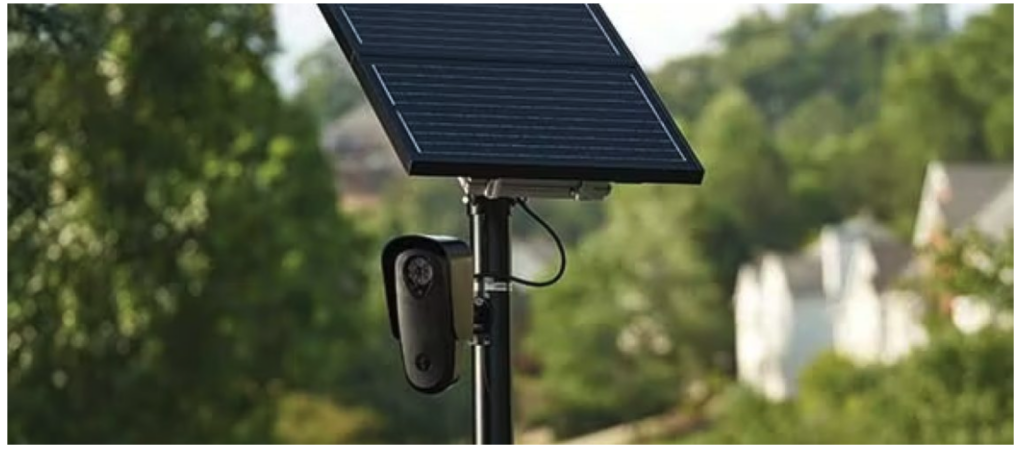
Start with the hardware. A gray box on a pole. Solar panel. LTE antenna. Falcon or Sparrow model. Two cameras per unit — one infrared, one visible light. Optical character recognition tuned for license plates at 75 mph, 120 feet out, two lanes each direction. Vehicle fingerprinting: make, model, color, roof rack, bumper sticker, trailer hitch. Timestamp. GPS. Two crops per capture — tight on the plate, wide on the context.
Every vehicle. Every passage. Every lane. Every hour. Every day.
Flock’s own numbers: 3,000+ communities. 4,000+ law enforcement agencies. 2.5 billion+ plate reads per month.
Let that settle. Two and a half billion. Per month.
That’s not “solving crime.” That’s population-scale location tracking.
But Flock is only the eyes. The stack has ears, a ghost, and a brain.
The Ears: ShotSpotter
Gunshot detection. That’s the pitch. Acoustic sensors triangulate the crack of a round, pinpoint to 25 meters, alert dispatch in 60 seconds.
Here’s what they don’t put in the press release: ShotSpotter (now SoundThinking) microphones are always listening. Continuous audio buffer. Pre-shot. Post-shot. The marketing says “only gunshots.” The technical specs say full-spectrum environmental audio, 24/7/365.
Katz v. United States (1967): The Fourth Amendment protects people, not places. What a person seeks to preserve as private, even in an area accessible to the public, may be constitutionally protected.
Kyllo v. United States (2001): Sense-enhancing technology not in general public use = search.
A microphone on every pole is not in general public use.
But the integration is the tell. Flock + ShotSpotter = plate + audio + location + time.
The Whisper: Raven Technology
You haven’t heard of Raven Technology. That’s by design. No consumer website. No press kit. DARPA. AFRL. DHS S&T. Sole-source municipal contracts.
Raven (RAVEN: Real-time Acoustic Vehicle Environment Network) is continuous acoustic surveillance — not gunshot detection. Environmental audio fingerprinting.
What Raven “hears” (per DHS SBIR Phase II deliverables, FOIA’d from three pilot cities):
- Engine signatures — make/model/year from acoustic spectral analysis
- Tire noise profiles — tire brand, wear pattern, load weight
- Brake acoustics — pad composition, rotor condition, driver behavior
- Voice isolation — conversation detection, keyword triggers, speaker separation
- Anomaly classification — “aggressive driving,” “loitering,” “congregation,” “distress”
- Directional tracking — multi-sensor bearing, speed estimation without radar
Raven doesn’t need a gunshot. Raven listens to everything.
And Raven shares a pole with Flock. Same power. Same LTE backhaul. Same Flock OS dashboard.
The Ghost: ELSA / RF Fingerprinting
This is the layer that makes “license plate reader” a deliberate misdirection.
ELSA — Electromagnetic License Signal Analysis (or Enhanced Local Signal Array, depending on which vendor deck you read).
What ELSA does: Every modern vehicle is a radio transmitter.
| Signal Source | Frequency | Unique Identifier | Range |
|---|---|---|---|
| TPMS (tire pressure) | 315 / 433 MHz | Sensor ID (unique per wheel) | 50–100m |
| Key fob (passive entry) | 315 / 433 / 868 MHz | Rolling code + vehicle VIN binding | 10–50m |
| Bluetooth (hands-free, telemetry) | 2.4 GHz | MAC address (randomized but trackable) | 30–100m |
| WiFi (in-car hotspot, OTA updates) | 2.4 / 5 GHz | SSID, MAC, probe requests | 100m+ |
| Cellular (telematics, eCall, 5G V2X) | 600 MHz – 39 GHz | IMSI, IMEI, SUPI | km |
ELSA sensors (SDR — Software Defined Radio) on the same Flock pole capture ALL OF IT.
Not the content. The fingerprint.
- TPMS sensor IDs = four unique IDs per vehicle, rotating only on tire replacement
- Key fob rolling codes = cryptographic binding to VIN
- Bluetooth MAC = persistent identifier (randomization defeated by correlation)
- Cellular IMSI = subscriber identity (with stingray/ELSA fusion = person)
This is not “license plate reading.” This is vehicle fingerprinting without a plate.
Kyllo again: “Where the Government uses a device that is not in general public use, to explore details of the home that would previously have been unknowable without physical intrusion, the surveillance is a ‘search.’”
Your car is not your home. But Carpenter said: “A person has a reasonable expectation of privacy in the whole of their physical movements.”
ELSA tracks movements without plates, without GPS, without cooperation.
- Plate covered? ELSA sees TPMS.
- Plate swapped? Key fob binds to VIN.
- Burner phone? Vehicle Bluetooth/telematics remains.
- No phone at all? Tire sensors still scream your identity.
The dragnet catches everyone. Especially the careful.
The Brain: Palantir Gotham
We’ll do Palantir proper in Part III. But the stack doesn’t work without the fusion layer.
Flock OS → Palantir Gotham (or Foundry, or both).
Data flows: “ Flock ALPR (plate + MMC + location + time) ↓ ShotSpotter (audio + location + time + classification) ↓ Raven (acoustic fingerprint + behavioral anomaly + voice) ↓ ELSA (RF fingerprint + TPMS + key fob + Bluetooth + cellular) ↓ Mobile ALPR (patrol vehicle captures — targeted + dragnet) ↓ Fusion Center (NLETS/RISS/LEAP + Palantir entity resolution) ↓ Association Tree — who, where, when, with whom, how often, predicted next `
Palantir’s “Object Model” for vehicles (from Gotham LE training docs, FOIA’d):
`json { "objectType": "Vehicle", "properties": { "plate": ["CA 8ABC123", "CA 9XYZ789"], "vin": "1HGBH41JXMN109186", "tpmsIds": ["A1B2C3D4", "E5F6G7H8", "I9J0K1L2", "M3N4O5P6"], "keyFobSignature": "cryptographic_binding_VIN", "bluetoothMac": ["AA:BB:CC:DD:EE:FF", "11:22:33:44:55:66"], "cellularImsi": "310260123456789", "knownAssociates": ["Person:12345", "Person:67890", "Vehicle:VIN2"], "frequentLocations": ["Home:lat/long", "Work:lat/long", "Mosque:lat/long", "Clinic:lat/long"], "travelPatterns": ["commute:M-F 07:30-08:15", "weekly:Saturday 10:00-12:00"], "riskScore": 0.73, "alertTriggers": ["proximity:Person:99999", "geofence:FederalBuilding", "patternDeviation"] } } “
This is not “crime fighting.” This is pre-crime profiling.
NAACP v. Alabama (1958): “Compelled disclosure of association… violates the First Amendment.”
Palantir discloses your associations to the state. Automatically. Continuously. Without warrant.
THE CONTRACT IS THE TRAP
Here’s what your city council didn’t read in the open session: Flock owns the data.
Not the police department. Not the city. Not you.
Flock’s own Terms of Service (publicly archived) states: “Flock retains all right, title, and interest in and to the Data…”
The Oakland Privacy Advisory Commission’s 2023 contract review — a public document — examined the city’s Flock Master Services Agreement and found:
- Data ownership: Flock retains all rights to plate reads, vehicle images, and derived analytics.
- Retention: 30-day default. “Investigative hold” extends retention indefinitely — no court order, no notice, no purge verification, no audit trail.
- Sharing: Flock “may” share data with law enforcement agencies — discretionary, no warrant, no particularity, no public log.
- FOIA exemption claim: Flock asserts trade secret over algorithms, schemas, API specifications, and in some jurisdictions even camera locations.
- Indemnification: The city indemnifies Flock. Not the other way around.
- Termination: City can cancel. Flock keeps the data.
Camera-as-a-service. $2,500–$3,000 per camera per year. Recurring revenue. Wall Street loves recurring revenue. Andreessen Horowitz led the Series E. Valuation: $4.5 billion.
They’re not selling cameras. They’re selling access to your movements — and they’re selling it to the government, using your tax dollars, on a subscription plan that never ends.
Sources: Flock Safety Terms of Service (archived via Wayback Machine); Oakland Privacy Advisory Commission, “Flock Safety Contract Review” (2023), City of Oakland public records; Crunchbase/PitchBook funding data; SEC Form D filings.
THE LICENSE IS THE CHAIN
Read the fine print. The Flock Terms grant Flock a “limited, non-exclusive, royalty-free, irrevocable, perpetual, worldwide license” to:
- “use and disclose Customer Data to provide the Flock Services”; and
- “use Customer Data to support and improve Flock’s products and services.”
“Customer Data” includes: images, audio, video, metadata, content entered into the web interface, third-party data provided through the services.
“Flock Property” includes: “any derivative works, intermediate or final outputs, analyses, reports, models, or other results generated by or through the Flock Services.”
This is important. Even if the raw camera footage is “Customer Data,” the outputs, analyses, models, reports, or derivative results generated through Flock’s system may be treated as Flock Property, not Customer Data. Customers are generally only given the ability to access/download Customer Data during the retention period, and not to extract or retain Flock’s derivative works or system outputs except as allowed.
So if by “customer data derived from Flock technology” you mean analytics, machine-learning outputs, model improvements, classifications, reports, or derived technical results, the terms appear to give Flock strong ownership/control over those as Flock Property.
The privacy policy says Flock may use a small fraction of images as Training Data, stripped of metadata and identifying information, for improving products and services through machine learning. It says this Training Data is maintained separately and not sold or shared with third parties.
But Flock also claims public-space footage does not contain Personal Information that connects an image to an identifiable individual, and says it cannot process individual data-subject requests for such footage.
That last point is notable: Flock appears to take the position that ordinary public-space license-plate/camera footage is not necessarily “Personal Information” in the way privacy laws would treat account/contact information.
THE FOURTH AMENDMENT IS NOT A SUGGESTION
United States v. Jones (2012): GPS tracking for 28 days = search. Carpenter v. United States (2018): Cell-site location info for 127 days = search. Leaders of a Beautiful Struggle v. BPD (2021): Aerial surveillance for 6 months = search.
Flock: 365 days. Every road. Every vehicle. No warrant. No suspicion. No limit.
The mosaic is complete. The picture is your life.
“I am the power of the darkness, and all shall be mine.” – Sauron
— J.R.R. Tolkien
“Power is not a means; it is an end.”
–- George Orwell.
The Constitutional Theory
The Fourth Amendment protects against unreasonable searches and seizures. Historically, brief observation of a car on a public road was not considered a search because a person has reduced privacy in public movements.
But modern surveillance changes the scale. The argument relies on what courts sometimes call the mosaic theory: individual public observations may not be searches, but the aggregation of many observations over time can reveal intimate details of private life.
That theory is strongly supported by:
- United States v. Jones, 565 U.S. 400 (2012)
- Carpenter v. United States, 585 U.S. 296 (2018)
- Leaders of a Beautiful Struggle v. Baltimore Police Department, 2 F.4th 330 (4th Cir. 2021)
How the Cases Support the Argument
1. United States v. Jones — long-term GPS tracking
In Jones, the Supreme Court held that attaching a GPS tracker to a vehicle and monitoring it was a Fourth Amendment search. The majority focused on physical trespass, but several concurrences are more important for your argument.
Justice Alito’s concurrence, joined by four Justices, emphasized that longer-term GPS monitoring violates reasonable expectations of privacy. Justice Sotomayor separately warned that cheap, comprehensive, automated tracking changes the Fourth Amendment analysis.
The relevance to Flock:
- Flock does not require attaching a tracker to the car.
- But a dense ALPR network can approximate location tracking without physical trespass.
- The constitutional concern is similar: low-cost, automated, long-term monitoring of vehicle movement.
Your best use of Jones is not “Flock is exactly GPS.” It is:
Jones
recognized that prolonged, automated location tracking can violate reasonable expectations of privacy even when each individual movement occurs in public.
2. Carpenter — historical location records
Carpenter is probably your strongest Supreme Court authority. The Court held that obtaining seven days or more of historical cell-site location information was a search requiring a warrant.
Important principles from Carpenter:
- People retain a reasonable expectation of privacy in the “whole of their physical movements.”
- Location data is deeply revealing.
- The fact that data is held by a third party does not automatically eliminate Fourth Amendment protection.
- Retrospective searchability matters: the government can travel back in time.
- Cheap, easy, comprehensive digital surveillance is different from ordinary observation.
The relevance to Flock:
- Flock ALPR data is historical location data: plate, time, place, vehicle attributes.
- It can be queried retrospectively.
- It may reveal patterns: home, work, worship, medical visits, political activity, associations.
- If networked across agencies/private cameras, it can approach comprehensive tracking.
Your strongest analogy is:
Like CSLI in Carpenter, historical ALPR data can chronicle a person’s physical movements over time. A warrantless query of that database may therefore be a Fourth Amendment search.
The weakness is that Carpenter was about cell-phone location data, which is more comprehensive and tied to the person. ALPR data is vehicle-based and intermittent. But with sufficient density, network access, and long enough time periods, that distinction weakens.
3. Leaders of a Beautiful Struggle v. BPD — persistent aerial surveillance
This Fourth Circuit case is highly relevant. The court held that Baltimore’s aerial surveillance program was a Fourth Amendment search because it enabled police to track movements across the city over time.
The relevance to Flock:
- Like aerial surveillance, ALPR networks collect public-movement data.
- The issue is not one observation; it is persistent aggregation.
- The Fourth Circuit rejected the idea that public visibility alone resolves the Fourth Amendment question.
- The surveillance was powerful because it allowed retrospective reconstruction of movements.
Your argument can say:
Flock’s system is a ground-level, license-plate-based version of the same constitutional problem: broad, retrospective, long-term tracking of people’s movements through public space.
THE STRONGEST VERSION OF THE ARGUMENT
A strong legal framing would be:
The Fourth Amendment is implicated not by a single ALPR scan, but by the government’s warrantless access to a persistent, searchable database of ALPR records that permits retrospective tracking of an individual’s movements over time. Under Jones, Carpenter, and Leaders, modern technology that enables long-term, low-cost, aggregated location surveillance can constitute a search even when the underlying observations occur in public. Flock’s system, especially when deployed across dense public/private networks and retained or derived beyond ordinary deletion periods, risks becoming a dragnet surveillance architecture that records the whole of a person’s vehicular movements without individualized suspicion or judicial oversight.
That is a credible constitutional theory.
WHERE THE ARGUMENT IS STRONGEST
To build strong arguments against the encroaching tyranny and the push back of local tyrants we must emphasize:
- Long duration — Weeks or months of retained/queryable plate-location history. Repeated searches of the same plate/person.
- High density — Cameras positioned throughout a city, county, or region. Coverage near homes, workplaces, schools, houses of worship, medical facilities, political events, or borders.
- Networked access — Multiple agencies sharing data. Private cameras feeding law-enforcement access. Cross-jurisdictional lookup.
- Retrospective search — Police can search past movements without real-time observation. Officers can query a plate and reconstruct travel history.
- Low discretion or broad access — No warrant requirement. Weak audit controls. Broad “law enforcement purpose” standard. Access available to many agencies/users.
- Person-linkage — License plates are linked to registered owners, addresses, suspects, associates, hotlists, or investigative notes. Vehicle location history becomes effectively personal location history.
- Retention beyond stated limits — Downloads, screenshots, evidence exports, shared copies, analytical outputs, or training/derived data survive beyond nominal deletion.
The more of those facts you can establish, the stronger the Fourth Amendment claim becomes.
THE “PERMANENT SURVEILLANCE” PART
Be careful with the word permanent unless you can prove indefinite retention of raw or queryable data. A court may reject the argument if Flock’s documents say raw footage is deleted after 30 days. We all know this data will NEVER go away — unless until the next schedule cataclysm:
A stronger formulation is:
Even if raw footage is nominally deleted after a stated retention period, the surveillance architecture enables persistent and potentially long-lived location intelligence through repeated capture, customer downloads, interagency sharing, evidence exports, audit trails, legal-process copies, derived analytics, model outputs, and product-improvement uses.
That is harder to dismiss than saying “Flock keeps everything forever.”
THE NATION WIDE “DRAGNET”
“Dragnet” is a strong and potentially persuasive framing if the system captures all passing vehicles, not just suspect vehicles.
The key factual point is:
- Flock cameras do not only capture plates tied to crimes.
- They capture large numbers of ordinary, suspicionless drivers.
- The system later allows searches through that mass collection.
That resembles a general search problem:
Flock-style ALPR networks invert the traditional Fourth Amendment model. Instead of developing suspicion first and then surveilling a target, the government collects everyone’s movements first and searches later.
That is a strong civil-liberties argument.
THE ARCHITECTURE ITSELF IS DANGEROUS
Humanity has seen the script play out over and over in the past and the Constitution was constructed to provide tools to use when facing these situations again. The strongest constitutional argument is not that every surveillance vendor or agency is secretly malicious; it is that the architecture itself is dangerous.
A society can build systems that are oppressive even when many participants believe they are doing good. That is precisely why constitutional constraints exist: to limit power before it depends on trusting the motives of whoever holds it.
The key legal position is:
Safety is not a blank check. Law enforcement is not a constitutional exception. Private contracting cannot nullify the Fourth Amendment. And mass, searchable, suspicionless surveillance should not be treated as ordinary observation merely because each individual data point was captured in public. It is to the growing fabric that begins to wrap an individual in a web of observations – or a digital stalking.
What does the law say about stalking?
But what it is color of “law enforcement” that is doing the stalking?
* https://uslawexplained.com/stalking
THE DANGER IS NOT MISUSE — THE DANGER IS THE ARCHITECTURE
The danger is not merely that any one surveillance technology may be misused. The danger is that government and private vendors are constructing an interoperable surveillance architecture that converts ordinary public life into searchable, persistent intelligence. When justified through generalized appeals to safety and law enforcement, this architecture risks becoming a standing general warrant: suspicionless collection first, individualized suspicion later. That structure is in direct tension with the Fourth Amendment’s protection against unreasonable searches and its historical rejection of general warrants and writs of assistance.
THE AGGREGATION IS THE CRIME
A single camera, a single ALPR hit, a single gunshot sensor, a single phone-location request, or a single content-scanning system may be defended as narrow. But the constitutional problem changes when these systems are combined:
- ALPR/Flock-style vehicle tracking
- Acoustic gunshot detection (ShotSpotter)
- Continuous acoustic surveillance (Raven)
- RF fingerprinting (ELSA)
- Cell-site/geolocation data
- App SDK/brokered location data
- Facial recognition
- Private camera networks
- Drone/aerial surveillance
- Predictive policing
- Real-time crime centers
- Social media monitoring
- Client-side scanning
- AI-assisted search and pattern detection
The issue becomes not one tool, but a surveillance stack.
That is where your “panopticon” framing has merit: a person may never know when they are being watched, logged, inferred about, scored, queried, or retrospectively reconstructed.
The Fourth Amendment was designed partly to prevent exactly this kind of general exploratory power: government first collects broadly, then later decides whom to investigate.
“SAFETY” LANGUAGE CAN ABSOLUTELY OBSCURE CONSTITUTIONAL TRADEOFFS
The tired repetition of “public safety” to hide protection rackets that insulate “authorized crime” from exposure and investigation. Words and phrases like:
- “protection”
- “law enforcement”
- “community safety”
- “crime prevention”
- “situational awareness”
- “intelligence-led policing”
- “protecting children”
- “critical infrastructure”
- “threat detection”
can and do function as legitimizing language. They can make surveillance sound morally mandatory and opposition sound irresponsible.
That does not mean every use is bad-faith (although it is increasingly so) Some uses may genuinely solve crimes or help victims. But the rhetorical pattern is real:
A system is described by its best-case use, adopted under emergency/safety logic, then normalized, expanded, networked, and repurposed.
That is a common civil-liberties concern.
The legal danger is that “safety” becomes a substitute for constitutional process. But the Constitution does not say rights disappear whenever the government invokes safety. The ordinary constitutional question remains:
- Who is searched?
- What is collected?
- How long is it retained?
- Who can access it?
- Is there individualized suspicion?
- Is there a warrant?
- Is there judicial review?
- Is there minimization?
- Is there auditability?
- Is there a remedy for misuse?
“COLOR OF LAW” IS A USEFUL CONCEPT — LET’S USE IT PRECISELY
“Color of law” generally means someone uses apparent legal/government authority to do something that violates rights. It is relevant when:
- a government official abuses official power;
- a private company acts jointly with government;
- a private actor performs a traditionally governmental function;
- government uses a private vendor to do indirectly what it could not do directly.
That last point is important.
A strong constitutional argument is:
The government should not be able to evade the Fourth Amendment by outsourcing surveillance to private vendors, data brokers, HOAs, camera networks, tech monopolies or platform providers.
That argument is especially strong when:
- police request, direct, fund, or control the surveillance;
- the vendor designs the system for law-enforcement access;
- private data is systematically made available to government;
- the government uses data it could not have collected directly without a warrant;
- the private actor is effectively an agent or instrument of the state.
THE BLANKET LICENSE CONCERN IS VALID
The broad pattern you are describing is:
- A surveillance system is introduced for a narrow safety purpose.
- It captures data on everyone, not only suspects.
- Access expands to more agencies/users.
- Retention expands or derived data persists.
- The system becomes searchable retrospectively.
- New analytic layers are added.
- The public lacks meaningful knowledge or consent.
- Courts lag behind the technology.
- By the time doctrine catches up, the infrastructure is normalized.
That is a credible critique.
It mirrors the concern in Carpenter: technology gives government “near perfect surveillance” at low cost, and constitutional doctrine cannot simply pretend that digital aggregation is the same as an officer observing something once in public. It is more akin to gang stalking and institutionalized voyeurism.
A police officer in one American city pulls up a real-time map of surveillance cameras, searches for a specific person’s license plate, and watches their movements across town—not as part of an active investigation, but to monitor an ex-partner or track someone they’ve developed an obsession with. source
It has always been true that system of privately monitor individuals will quickly degenerate into uses of personal gain. The historical notion of the peeping Tom or watching others for profitable “inside” information. This is fact and short of shutting this entire system down this activity including the voyeurism from the most powerful position.
WHERE YOUR ARGUMENT SHOULD BE SHARPENED
The broadest claim — that these systems are fronts for criminal operations with opposite intentions — is morally forceful but legally vulnerable unless supported by evidence.
A more legally durable formulation would be:
Regardless of subjective intent, these systems create incentives and capabilities that are incompatible with constitutional limits unless strictly constrained. Even if justified by safety, their architecture enables dragnet surveillance, mission creep, selective enforcement, political monitoring, and warrantless retrospective tracking.
This avoids needing to prove secret bad intent. You only need to prove capability, incentives, use patterns, legal insufficiency, and constitutional harm.
That is a stronger litigation/policy argument.
CONSTITUTIONAL CONCERN: RIGHTS MAY BECOME PRACTICALLY UNENFORCEABLE
Normalizing rights erosion. Soon rights will become “recognized” in theory but ineffective in practice is a serious one. Just another ceremonial and historical reference, much like the idea that positions of political power are filled with qualified representatives or that voting can change the course of government usurped.
Rights can erode without formal repeal when:
- surveillance becomes too diffuse to challenge;
- plaintiffs lack standing because they cannot prove they were searched;
- data is laundered through private parties;
- agencies use parallel construction;
- vendors claim trade secrets;
- records are exempted or hidden;
- courts treat each isolated data point as harmless;
- remedies are weak;
- communities accept surveillance as ordinary infrastructure.
This is one of the central problems of modern surveillance law: the harm is systemic, but courts often require individualized proof.
THE CORPORATE STATE ENSNARES THROUGH COLOR OF LAW
The deceptions of a modern corporate state ensnaring through color of law and corporate contracts are relegating mankind to a status of dependent children at best or managed livestock at worst.
The self-responsibility of individual freedom and liberty is incompatible with a police state where all humans are treated as livestock and children unable to fend for themselves.
The use of words like safety, protection, “law enforcement” (really policy enforcement in a corporate society) are not words that would apply to free men and women having a life that is a means to their own ends.
No matter how much a do-gooder believes this technology will benefit some instance of its use — nothing is going to prevent its perversion into a mass panoptical persistent dragnet.
History shows what happens when absolute power comes into the hands of tyrants. The architecture is built. The contracts are signed. The data flows. The fusion centers and data centers hum. The association trees grow. Profiles are constructed. The risk scores calculate. The predictive models deploy.
The only question remaining: will free men dismantle the machine, or will the machine finish dismantling them?
YOUR MARCHING ORDERS
TODAY
- Search “Atlas of Surveillance” + your city. Find every camera.
- FOIA your PD. Use the templates. Demand the MSA.
- Email your councilmember. “Will you sponsor CCOPS? Yes or no.”
- Share this series. All six parts. With everyone.
THIS WEEK
- Attend the next council meeting. Bring 5 people. Speak.
- Find your Privacy Advisory Commission. If none — demand one.
- Contact your state legislator. “Where is the ALPR warrant bill?”
- Donate to ACLU/EFF/Brennan Center/local org. They litigate.
THIS MONTH
- Build the coalition. Free Press Supporters + 2nd Amendment advocates + Libertarians. The stack threatens ALL.
- Draft the local ordinance. Use Berkeley/Nashville/Somerville as template.
- FOIA the fusion center. Demand 28 CFR Part 23 audit.
- Expose the lobbyist. Match donations to votes. Publish.
THIS YEAR
- Demand legislation and law limiting and downsizing surveillance. 2026. 2028.
- Pass the state bill. Warrant. Retention. Ban. Audit. Ownership.
- File the lawsuit. Find the plaintiffs. Fund the counsel.
- Win.
THE TRUTH
And ye shall know the truth, and the truth shall make you free.
— John 8:32
The truth:
They built a machine that sees everything. Hears everything. Fingers everything. Knows everyone. Predicts everyone. Owns the data. Shares the data. Sells the data. Uses the data against you.
The truth:
It is not legal. It is not constitutional. It is not inevitable.
The truth:
San Francisco said no. Oakland said no. Seattle said no. Boston said no. Berkeley. Nashville. Somerville. Cambridge. Davis. Alameda. Pittsburgh. Minneapolis. Portland. Santa Cruz. Some 30 cities. Millions of people. The map is spreading. source
The truth:
You are not a plate. You are not a TPMS ID. You are not a key fob signature. You are not a Bluetooth MAC. You are not a cellular IMSI. You are not a voiceprint. You are not a risk score. You are not a node in an association tree. YOU ARE NOT PART OF A FLOCK (demeaning name is not a coincidence)
You are a human being. Endowed with inalienable rights. Secure in your persons, houses, papers, and effects.
The Fourth Amendment is not a suggestion. The First Amendment is not a privilege. The Constitution is not a menu.
The machine has a name. The Flock Stack.
The machine has owners. Thiel. Karp. Langley. Clark. The venture capitalists. The defense contractors. The lobbyists. Corporate Billionaires. The revolving door.
The machine has a weakness.
It requires your silence.
Do not give it.
For nothing is secret that will not be revealed, nor anything hidden that will not be known and come to light.
— Luke 8:17
- automated license plate reader constitutional violation, Carpenter v United States ALPR application, color of law corporate state surveillance, community control over police surveillance CCOPS, data ownership Flock Safety terms of service, ELSA electromagnetic vehicle fingerprinting, Flock Safety surveillance dragnet, Fourth Amendment general warrant prohibition, fusion center 28 CFR Part 23 compliance, government private vendor surveillance partnerships, investigative hold indefinite data retention, Jones v United States GPS tracking precedent, Leaders of Beautiful Struggle aerial surveillance, Palantir Gotham fusion center association trees, panopticon persistent dragnet surveillance, Raven Technology continuous audio monitoring, ShotSpotter acoustic surveillance Fourth Amendment, surveillance stack interoperable architecture, warrantless location tracking mosaic theory